

Cart
0
Table of Contents
- Why Wilderness First Aid Training Matters for Hikers
- Core Skills Taught in Wilderness First Aid Training
- Wilderness First Aid vs Standard First Aid
- How Long Is a Wilderness First Aid Course?
- Building Your Wilderness First Aid Kit Checklist 2026
- Beyond the Course: Retention, Psychology, and Gear-Specific Skills
- Frequently Asked Questions
Last Updated: September 29, 2026
Why Wilderness First Aid Training Matters for Hikers
The nearest ambulance is often two hours away on a trail. That gap between injury and professional care is exactly what wilderness first aid training for hikers prepares you to close. This guide from RestockYourKit.com covers what the courses teach, how long certification takes, and what belongs in your pack.

That's a different job than waiting for an EMT.
Watch Out
The most common mistake new hikers make is treating a WFA certification as a one-time checkbox. Skills like splinting and patient monitoring degrade quickly without practice, and a card in your wallet won't stabilize a fracture.
Core Skills Taught in Wilderness First Aid Training
Every reputable course builds around one spine: the patient assessment system. You learn to run a scene size-up, check vital signs, complete a head-to-toe exam, and record findings in a SOAP note before deciding on treatment or evacuation.
The skills that show up in nearly every curriculum:
- Trauma assessment and injury stabilization, including splinting, tourniquet application, and wound management
- Environmental emergencies, covering hypothermia prevention, heat illness, and altitude sickness
- Medical emergencies, including anaphylaxis, cardiac events, and shock
- Evacuation protocols, from improvised litter construction to when to send for help versus move the patient
- Triage and medical decision making when you're managing more than one person
Wilderness First Aid vs Standard First Aid
Wilderness first aid training for hikers covers everything a standard course does, plus the judgment calls that only matter when help is far away. Standard first aid teaches you to stabilize and hand off. Wilderness training teaches you to stabilize, monitor, and decide.

| Feature | Standard First Aid | Wilderness First Aid |
|---|---|---|
| Response time assumption | Under 10 minutes | Over 1 hour |
| Course length | 4-8 hours | 16-24 hours |
| Patient monitoring | Minimal | Continuous, documented |
| Evacuation decisions | Not covered | Core curriculum |
| Improvised equipment | Rarely taught | Standard practice |
| Certification period | 2 years | 2-3 years |
How Long Is a Wilderness First Aid Course?
A standard wilderness first aid course runs 16 to 20 hours, typically over two days or a weekend; some providers use a hybrid format with online coursework plus an in-person skills day. The hands-on hours are non-negotiable: splinting, patient assessment loops, and evacuation drills cannot be learned from a video.
| Course Type | Hours | Typical Format | Best For |
|---|---|---|---|
| Standard First Aid + CPR | 4-8 | Single day | Frontcountry day hikers |
| Wilderness First Aid (WFA) | 16-20 | Two days or weekend | Weekend backpackers, scouts, trip leaders |
| Wilderness First Responder (WFR) | 70-80 | 8-10 days | Guides, thru-hikers, remote expedition leaders |
| WFA Recertification | 8 | Single day | Anyone whose card is expiring |
Pro Tip
Before you book, confirm three things: (1) the course includes a current CPR prerequisite or add-on, (2) the certification is recognized by the organizations you hike with (scouting groups, guide services, and some land managers have specific requirements), and (3) the recertification window so you don't let it lapse mid-season.
Building Your Wilderness First Aid Kit Checklist 2026
A wilderness first aid kit should match your group size, trip duration, and distance from help, the kit for a solo day hike is not the kit for a five-day group trip.
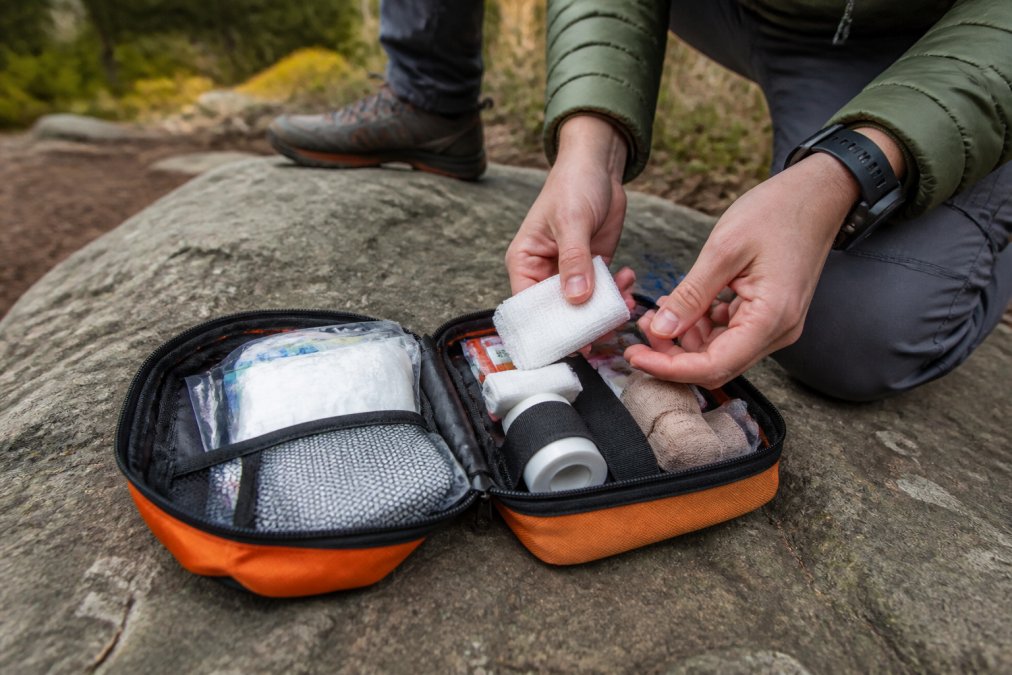
Start with the essentials and build outward:
- Nitrile gloves and a CPR mask
- Trauma shears and splinter forceps
- Adhesive bandages in multiple sizes plus gauze pads and rolls
- Blister care: moleskin, blister pads, and tincture of benzoin
- Elastic bandage and triangular bandage for orthopedic injuries
- Medications: antihistamine, ibuprofen, antacid, and electrolyte tablets
- Wound care: antibiotic ointment, alcohol wipes, povidone-iodine wipes
- Tick removal tool with an identification card
- A SOAP note pad and a biohazard bag
Pro Tip
Pack your kit by module, not by item. Group wound care, blister care, and medications into separate resealable bags so you're not dumping the whole kit on the ground while a patient waits. RestockYourKit.com ships every kit with contents in individual waterproof resealable poly bags for exactly this reason.
Beyond the Course: Retention, Psychology, and Gear-Specific Skills
Certification is the starting line, not the finish. Skill retention drops fast without practice, and the psychological side of remote emergencies is the part almost no course covers well.
Scenario-Based Decision Trees
Instead of memorizing treatments, rehearse decisions. Build a set of if-then branches for the injuries you're most likely to face, and write them out before you need them.
Ankle injury decision tree:
- Can the patient bear weight? → If yes, treat as a sprain: RICE, wrap, monitor, continue with reduced load.
- Can the patient bear weight? → If no, and there's deformity, point tenderness over the malleolus, or inability to take four steps → treat as a possible fracture: splint, do not remove the boot if swelling is severe, prepare for evacuation.
- Is there numbness, tingling, or loss of pulse below the injury? → Neurovascular compromise: splint in place, evacuate immediately, do not attempt to realign.
Suspected hypothermia decision tree:
Wilderness Medicine: What To Do When →
- Is the patient shivering and alert? → Mild: shelter, dry layers, warm fluids, monitor.
- Is the patient shivering stopped but still conscious? → Moderate: aggressive rewarming, no walking, evacuate.
- Is the patient confused, drowsy, or unconscious? → Severe: handle gently, horizontal transport, evacuate immediately, rough movement can trigger cardiac arrest in severe hypothermia.
Anaphylaxis decision tree:
- Known allergen exposure + hives + respiratory distress → epinephrine auto-injector, then antihistamine, then evacuate.
- No known exposure but sudden swelling, wheezing, or hypotension → treat as anaphylaxis, use epinephrine if available, evacuate.
Psychological First Aid in Remote Settings
Panic spreads faster than hypothermia. A frightened patient can hyperventilate, refuse treatment, or bolt; a frightened bystander can freeze or make things worse. Managing the psychological dimension is a trainable skill most courses skip entirely.
Three practices that work in the field:
- Name the situation out loud. "You've twisted your ankle. We're going to wrap it, check your circulation, and decide whether we walk out or call for help. I'm going to tell you each step before I do it." Naming reduces uncertainty, and uncertainty is what drives panic.
- Assign tasks to bystanders. A person with a job is a person who isn't panicking. "You, hold the light. You, get the pad and pencil and write down everything I say." This also gives you a second set of hands and a record.
- Manage your own stress first. If you're breathing fast and your hands are shaking, the patient will mirror it. Take three slow breaths before you touch the patient. This is not a metaphor, it's a physiological reset that changes your voice, your hands, and your decisions.
Post-Course Skill Retention
A card in your wallet won't stabilize a fracture. Most WFA certifications last two to three years, but research on skill decay in emergency medicine shows retention drops significantly within six months without practice. The skills that decay fastest are the ones you use least: tourniquet application, litter construction, and the full head-to-toe assessment.
A simple retention routine:
- Monthly (10 minutes): Open your kit. Check expiration dates. Repack it by module. Confirm you can find the trauma shears in the dark.
- Quarterly (30 minutes): Run one scenario out loud. Pick an injury, walk through the assessment sequence, and say your treatment decisions aloud. This is called "talk-through practice" and it's how pilots and surgeons maintain procedural memory.
- Annually: Take a recertification course or a skills refresher. Many providers offer one-day recerts that focus entirely on hands-on practice.
- Before every major trip: Review your decision trees for the injuries most likely on that route. A desert hike has different priorities than a snow traverse.
Gear-Specific First Aid
Your kit should reflect your actual gear and risks. Blister care matters more for thru-hikers than paddlers; tick-borne illness prevention matters more in tick country. Cold-weather trips need more hypothermia supplies; desert trips need more electrolyte and heat-illness supplies. Balancing these medical necessities against the total weight of your pack requires a strategic approach to selecting lightweight hiking gear that serves both safety and efficiency on the trail.
Three gear-specific adjustments worth making:
- Ultralight hikers: Carry a modular kit that weighs under 10 ounces but includes trauma shears, a CPR mask, and a blister module. Skip the bulky splint, learn to improvise with trekking poles and a sleeping pad.
- Group expedition leaders: Carry a larger kit with duplicate critical items (two tourniquets, two CPR masks), a SOAP note pad for documentation, and a dedicated trauma module. You're the definitive care provider for the whole group.
- Solo remote hikers: Carry a satellite messenger or personal locator beacon alongside your kit. The best first aid kit in the world doesn't help if you can't call for evacuation. Pair your kit with a communication plan.
Frequently Asked Questions
What is the difference between standard first aid and wilderness first aid?
Standard first aid assumes EMS arrives in minutes, so it focuses on CPR, bleeding control, and calling for help. Wilderness first aid training prepares you for when help is an hour or more away. You learn extended patient monitoring, improvised splinting, evacuation decision-making, and how to manage conditions like hypothermia or anaphylaxis with limited supplies. The scope is wider and the timeline is longer.

How long does a wilderness first aid certification last?
Most wilderness first aid certifications last two to three years, depending on the provider. After that, you typically need a recertification course, which runs about half the length of the original training. Because CPR guidelines and treatment protocols update periodically, recertifying keeps your skills current. Check your course provider's specific expiration policy before your card lapses.
Do I need wilderness first aid training for day hikes?
Day hikes on well-trafficked trails rarely require it, but remote or solo day hikes change the math. If a twisted ankle or allergic reaction could leave you hours from a trailhead, the skills pay off. Many hikers start with a basic course, then carry a compact kit. Wilderness first aid training gives you the judgment to decide whether to evacuate or wait for rescue.
What should I put in a wilderness first aid kit for hiking?
A solid wilderness first aid kit checklist 2026 includes nitrile gloves, a CPR mask, trauma shears, gauze pads and rolls, adhesive bandages, blister care like moleskin, an elastic bandage, a triangular bandage, and medications such as diphenhydramine, ibuprofen, and antibiotic ointment. A SOAP note pad and a tick removal tool round it out. Match kit size to group size and trip length.


