

Cart
0

Table of Contents
- Step 1: Assess Your Workplace Risks and Inventory Needs
- Step 2: Follow the OSHA First Aid Kit Checklist for Compliance
- Step 3: Audit Your Kit with a First Aid Kit Inspection Log Template
- Step 4: Track Expiration Dates and Rotate Medical Supply Replenishment
- Step 5: Choose Replacement Items and Refill Kits That Fit Your Budget
- Step 6: How to Choose a First Aid Restocking Vendor
- Step 7: Dispose of Expired Medical Waste and Set a Restocking Schedule
- Common Mistakes to Avoid When You Restock Medical Kits
- Frequently Asked Questions
Last Updated: September 30, 2026
Step 1: Assess Your Workplace Risks and Inventory Needs
Before you restock medical kits, you need to know what your workplace actually risks. A restaurant kitchen and a landscaping crew face very different hazards, and your supplies should reflect that.
Start with a simple walkthrough. Note the tools, chemicals, and tasks your team handles daily.
Then compare those risks against what's currently in your kit. Most small businesses find gaps in two areas: burn care and heavy bleeding supplies.
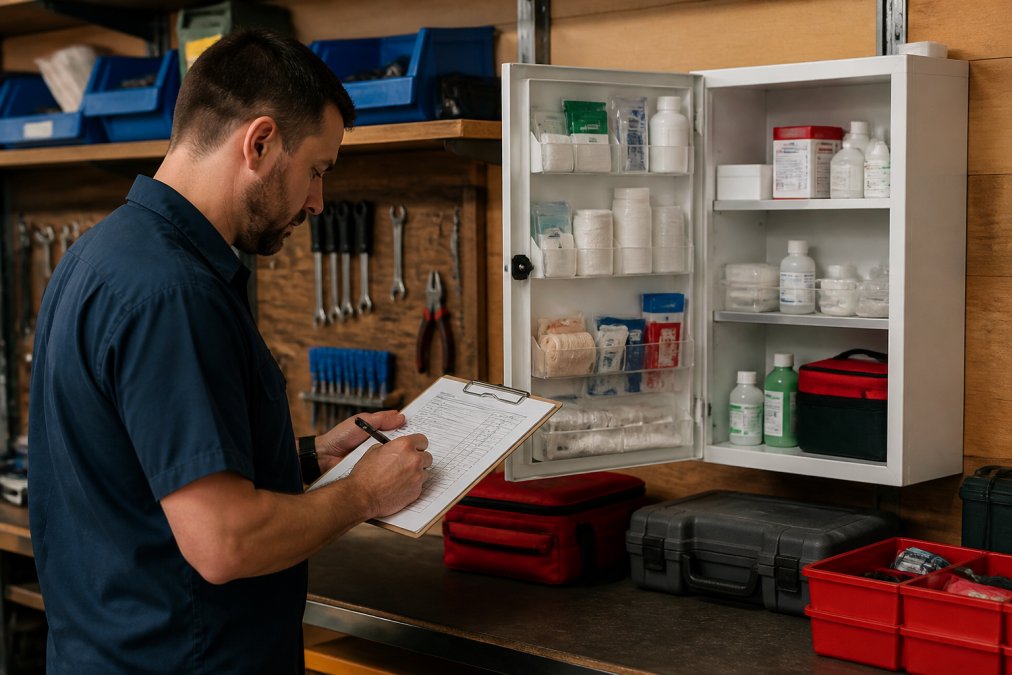
Ask yourself:
- What injuries happen most often here?
- How far is the nearest hospital?
- How many people work each shift?
A risk assessment is the foundation of any restocking plan. Skip it, and you'll buy supplies you never touch while missing the ones you need.
Step 2: Follow the OSHA First Aid Kit Checklist for Compliance
OSHA does not publish a single mandatory first aid kit contents list. Instead, the general industry standard at 29 CFR 1910.151(b) requires that "adequate first aid supplies be readily available" and that a person trained to render first aid be accessible at the worksite. What counts as "adequate" is defined by your hazard assessment, not by a fixed SKU list, which is why a generic big-box kit rarely satisfies a compliance review on its own.
Two other OSHA rules shape what you stock:
- 29 CFR 1910.151(c) requires eyewash and quick-drench facilities where employees may be exposed to corrosive materials. If your team handles cleaning chemicals, degreasers, or battery acid, your kit restock should include sterile eyewash solution and a plumbed or portable eyewash station.
- 29 CFR 1904 governs injury and illness recordkeeping. If a workplace injury requires more than basic first aid, stitches, prescription medication, broken bone, loss of consciousness, it becomes a recordable incident on OSHA Form 300. That distinction matters because it tells you which supplies are "first aid" (bandages, non-prescription meds, wound cleaning) versus which signal a recordable event.
A defensible OSHA-aligned kit typically includes:
- Adhesive bandages in assorted sizes, including knuckle and fingertip shapes
- Sterile gauze pads (2x2 and 4x4) and rolled gauze
- Adhesive tape and elastic wrap
- Antibiotic ointment and antiseptic wipes
- Non-latex exam gloves (stock at least two sizes)
- Scissors, tweezers, and a thermometer
- CPR face shield or barrier device
- Instant cold packs and an emergency blanket
- Eyewash solution if corrosives are present
- Burn gel or burn dressing if heat, steam, or hot oil is present
State-plan states add their own layer. Roughly half the states operate their own OSHA-approved programs (California, Washington, Oregon, Michigan, Kentucky, and others).
OSHA first aid requirements and state-plan map
Key Takeaway
OSHA compliance is not a kit contents list, it is a documented match between your hazards, your supplies, and your training. Keep the hazard assessment from Step 1 on file next to your inspection log so a compliance officer can trace the logic.
One more mechanism worth knowing: OSHA's "reasonably accessible" language means a kit locked in a manager's office that only opens during business hours may not qualify for a second-shift crew. If you run multiple shifts, either stock a second kit or move the primary kit to a location every employee can reach during their working hours.
Step 3: Audit Your Kit with a First Aid Kit Inspection Log Template
An inspection log turns guesswork into a repeatable process. You check the kit, write down what's missing, and reorder only what you need.
Build your log with these columns:
- Item name
- Quantity required
- Quantity on hand
- Expiration date
- Action needed
Pro Tip
Photograph your fully stocked kit right after you restock it. Tape the photo inside the cabinet lid. Anyone can then see at a glance what "full" should look like.
Step 4: Track Expiration Dates and Rotate Medical Supply Replenishment
Expired supplies are the quiet failure point in most kits. Medications lose potency, and sterile packaging can break down over time.
Band-Aid Assortment (REFILL KIT) →
Check these items most often:
- Pain relievers and antihistamines
- Antibiotic ointment
- Sterile gauze and dressings
- Adhesive bandages
Step 5: Choose Replacement Items and Refill Kits That Fit Your Budget
Buying individual items at retail adds up fast. Refill kits bundle the common supplies at a lower cost per item.
| Refill Kit | Price | Best For |
|---|---|---|
| Band-Aid Assortment | $4.49 | Cuts and minor scrapes |
| Gauze | $6.49 | Wound care and bleeding control |
| OTC Pain | $4.99 | Aches, fever, inflammation |
| Super Basics | $5.99 | Allergies, stomach upset, pain |
Step 6: How to Choose a First Aid Restocking Vendor
- Annual supply spend, total cost of refill kits and individual items across all kits.
- Labor cost of restocking, hours per year spent auditing, ordering, receiving, and rotating, multiplied by the loaded hourly wage of the person doing it. A common pattern is 8-16 hours per year for a single kit, more for multi-site operations.
- Expiration waste, dollar value of supplies you discard unused because they expired before you used them.
- Compliance risk, the cost of a citation, an injury with inadequate supplies, or a failed safety review. This is hard to quantify but should be weighted heavily.
Vendor evaluation criteria that actually matter:
- Minimum remaining shelf life on arrival. Ask for a written commitment.
- Unit-of-sale flexibility. Can you buy a single 4x4 gauze pad refill, or only a 500-count case?
- Catalog depth across categories. One vendor for bandages, medications, PPE, and specialty items (burn care, eyewash, animal first aid) can simplify ordering.
- Shipping thresholds and lead time. Free shipping over a set dollar amount only helps if your order size clears it. Otherwise, factor shipping into your per-restock cost.
- Return and replacement policy on expired or damaged goods. Get it in writing before the first order.
- Disposal support. Does the vendor or a partner offer mail-back disposal for expired medications or sharps? This is rare but increasingly valuable given the disposal rules in Step 7.
Questions to ask before you commit:
- What is your minimum remaining shelf life on sterile and medication items?
- Do you sell individual quantities or only bulk cases?
- Can you handle specialized needs like animal first aid or food-service burn care?
- What is your return policy on expired or damaged goods?
- Do you offer any disposal or take-back support?
Pro Tip
Request a sample order before committing to an annual contract. Check the expiration dates on what arrives.
DIY vs. managed service, a quick decision rule. If your annual supply spend is under a few hundred dollars and you have one or two kits, DIY with refill kits can be a cost-effective option. If you have multiple sites, high staff turnover, or a compliance-sensitive industry (food service, healthcare, childcare, construction), pricing a managed service may offer labor and liability savings.
Step 7: Dispose of Expired Medical Waste and Set a Restocking Schedule
Expired medications and used supplies need proper disposal. Don't toss loose pills in the trash where pets or kids can reach them.
Watch Out
Skipping disposal rules can bring fines and put your team at risk. Loose medications in open trash are a hazard, and some states treat improper medical waste disposal as a violation.
Common Mistakes to Avoid When You Restock Medical Kits
The biggest mistake is restocking without checking expiration dates first. You end up with a kit full of supplies that expire next month.
Other common errors:
- Buying one giant bulk case for a small team, then watching it expire
- Forgetting to replace gloves and CPR barriers
- Storing the kit somewhere hard to reach in an emergency
- Letting one person own the task with no backup
Frequently Asked Questions
Who is responsible for restocking the first aid kit in a small business?
In most small businesses, the safety officer or a designated employee handles restocking. OSHA requires employers to ensure adequate first aid supplies are available, but does not specify a single role. Many companies assign this to an office manager, HR representative, or safety committee member. The key is to document who is responsible in your written safety plan and give that person the authority to order supplies. A clear first aid kit inspection log template can help track who checked the kit and when.
How often should a first aid kit be checked and restocked?
OSHA does not set a specific frequency, but industry best practice is to inspect kits monthly and restock immediately after any use. For high-traffic workplaces or those with higher injury risk, weekly checks are safer. Set a recurring calendar reminder and use a first aid kit inspection log template to record each check. Replace missing items right away, and review expiration dates quarterly. If your kit is exposed to extreme temperatures, inspect more often because heat and cold can degrade supplies.
Is it more cost-effective to buy a pre-filled kit or restock individual supplies?
For most small businesses, restocking individual supplies is cheaper long-term because you only buy what you actually use. Pre-filled kits often include items you never touch, and replacing the entire kit wastes money. Buying replacement items in bulk or as refill kits lowers per-unit cost. For example, RestockYourKit.com offers a Band-Aid Assortment Refill Kit for $4.49, a Gauze Refill Kit for $6.49, and an OTC Pain Refill Kit for $4.99. These targeted refills keep your kit current without overbuying.
How do I ensure my medical kit remains ANSI compliant?
ANSI/ISEA Z308.1 sets the minimum contents for workplace first aid kits. To stay compliant, start with a kit that meets the current standard, then restock only with items that match or exceed the required specifications. Check expiration dates regularly and replace anything expired. Keep a written inventory and inspection log. If your workplace has unique hazards, add extra supplies beyond the minimum. Review the standard every few years because ANSI updates it periodically. When you restock medical kits, verify that replacement items are equivalent to the originals in type and quantity.
Keeping a workplace kit ready takes more than a yearly glance. Supplies expire, items run out, and hazards change as your team grows. RestockYourKit.com makes the cycle simple with flexible refill kits, individual quantities at near-wholesale prices, and free shipping on orders of $79 or more. Get started with RestockYourKit.com and keep your safety equipment current, compliant, and ready when it counts.


