

Cart
0
Table of Contents
- Trauma Kit vs. First Aid Kit: What Your Business Actually Needs
- Assessing Workplace Hazards and Trauma Risk
- Workplace Trauma Kit Contents: What Saves Lives
- First Aid Kit Size by Employee Count
- Compliance and Regulatory Requirements
- Trauma Kit Restocking and Inspection
- Deployment, Training, and Response Planning
- Frequently Asked Questions
Last Updated: October 15, 2026
Trauma Kit vs. First Aid Kit: What Your Business Actually Needs
The difference between a trauma kit and a standard first aid kit isn't just about the contents, it's about response time and severity. A trauma kit for businesses addresses life-threatening injuries that can't wait for emergency responders. A first aid kit handles minor cuts, sprains, and burns. When someone is bleeding heavily from a wound, a standard first aid kit won't save their life. A trauma kit will.

Many business owners assume a basic first aid kit covers all emergencies. It doesn't. According to Department of Homeland Security's STOP THE BLEED program, a person can bleed to death in as little as 3-5 minutes, faster than many emergency response systems can arrive. That's why rapid access to bleeding control supplies matters.
A trauma kit for businesses includes tourniquets, hemostatic gauze, chest seals, and pressure dressings designed for severe hemorrhage and penetrating injuries. A first aid kit includes adhesive bandages, sterile gauze pads, antiseptic wipes, and over-the-counter pain relievers. Both have their place, but they serve different purposes. The real question isn't which one to choose, it's whether your business has both, and whether they're positioned where they're needed most.
Key Takeaway
Trauma kits address life-threatening bleeding and chest wounds. First aid kits handle minor injuries. Most businesses need both, positioned strategically for different scenarios.
Assessing Workplace Hazards and Trauma Risk
Your industry and workplace environment determine whether you need a trauma kit, a first aid kit, or both. Construction sites, manufacturing facilities, and warehouses face higher trauma risk than office environments. But trauma risk exists everywhere, active shooter incidents, vehicle accidents, and severe lacerations can happen in any setting.
Start by identifying the types of injuries most likely in your workplace. Manufacturing environments with heavy machinery face crush injuries and severe lacerations. Construction sites deal with falls, puncture wounds, and head trauma. Retail and office environments have lower trauma risk but aren't immune to serious incidents.
Once you've identified your hazards, assess the response time. How long until emergency responders arrive? In urban areas, that's often 5-10 minutes. In rural settings, it can be 30 minutes or more. The longer the response time, the more critical it is to have bleeding control supplies on hand.

Consider also the size and nature of your workforce. A small office with five employees has different needs than a manufacturing plant with 50 workers across multiple shifts. A business with employees working at heights, with machinery, or in remote locations faces different trauma scenarios than one with a stable, low-risk environment.
Watch Out
Underestimating your workplace trauma risk leaves your team unprepared. If an incident occurs and supplies aren't available, response time to emergency care becomes the only factor, and that's often too late.
Workplace Trauma Kit Contents: What Saves Lives
A trauma kit for businesses must contain specific items designed for severe bleeding and life-threatening injuries. The core components are tourniquets, hemostatic gauze, pressure dressings, chest seals, and personal protective equipment.
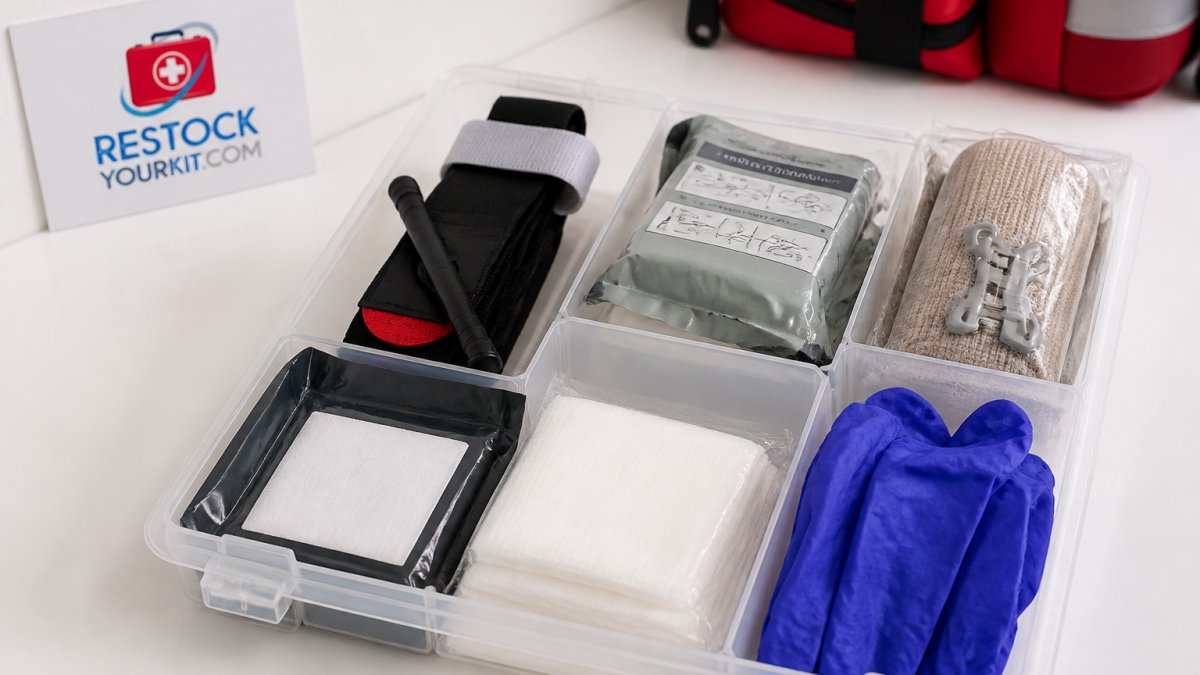
A tourniquet is the first line of defense for severe limb bleeding. The North American Rescue C-A-T tourniquet is the standard in trauma response, it's approved by the U.S.
Hemostatic gauze (like QuikClot) stops bleeding chemically. When packed directly into a wound, it activates clotting factors and can control hemorrhage that direct pressure alone cannot.
Pressure dressings (Israeli bandages) provide sustained pressure to control bleeding. They're larger than standard gauze and designed to wrap around wounds while maintaining consistent pressure.
Chest seals (like the HyFin Vent Chest Seal) address penetrating chest wounds. A puncture wound to the chest can cause a pneumothorax, air entering the chest cavity that collapses the lung.
Personal protective equipment (gloves, face shields) protects responders from bloodborne pathogens. Nitrile gloves are standard, latex-free, and durable.
Emergency shears allow responders to quickly remove clothing and expose injuries without wasting time on buttons or zippers. Every second counts in trauma response.
The RestockYourKit.com Bleeding Control Kit - Customizable comes in two styles. The Basic version ($125.00) includes a C-A-T tourniquet, compressed gauze, trauma shears, nitrile gloves, and a marker.
First Aid Kit Size by Employee Count
The size of your first aid kit should match your workforce size and the nature of your workplace. A small office with 5-10 employees needs a different kit than a manufacturing facility with 100 workers. The rule isn't just about numbers, it's about ensuring supplies are accessible and not depleted by routine use.
| Employee Count | Recommended Kit Type | Rationale | Typical Contents |
|---|---|---|---|
| 1-10 | Compact/Portable | Single kit covers all employees; easy to maintain and restock | Basic bandages, gauze, tape, antiseptic, pain relievers |
| 11-50 | Standard + Trauma Module | Primary kit plus dedicated trauma supplies; higher injury probability | Standard first aid plus tourniquet, hemostatic gauze, chest seal |
| 51-100 | Multiple Stations | Station-based deployment; ensures accessibility across workplace | Distributed kits at key locations plus centralized trauma supplies |
| 100+ | Multi-Station + Trauma | Redundancy and coverage; multiple trauma kits at strategic locations | Comprehensive coverage with backup supplies and regular restocking |
Small businesses often make the mistake of buying one oversized kit and storing it in a back office. If an injury happens on the production floor, the kit is too far away. Better to have multiple smaller kits positioned where injuries are most likely, near machinery, at entry points, in break rooms.

For businesses with higher trauma risk, dedicate at least one trauma module separate from the general first aid kit. This ensures that when a severe bleeding incident occurs, trauma supplies aren't depleted from treating minor cuts and scrapes. A trauma kit for businesses should be clearly labeled and accessible to trained responders, not buried in a cabinet.
Pro Tip
Position first aid kits at multiple locations based on workplace layout, not just one central location. A kit that's hard to reach in an emergency is nearly useless.
Compliance and Regulatory Requirements
First aid kit requirements vary by state and industry. OSHA (Occupational Safety and Health Administration) doesn't mandate specific first aid kit contents, but it does require employers to provide "readily available" first aid supplies appropriate to the workplace. What's "appropriate" depends on the hazards present.
Some states have more specific requirements. For example, certain states require workplaces with specific machinery or hazards to have specific first aid supplies on hand. Construction sites often have stricter requirements than office environments. Healthcare facilities have their own regulations around medical supplies.
Bleeding Control Kit - Customizable →
The key is understanding your state's requirements and your industry's standards. A construction company operating in multiple states needs to comply with each state's regulations. A manufacturing facility using certain chemicals may have specific first aid requirements tied to those materials.
Beyond legal compliance, consider industry best practices. The American Red Cross and similar organizations provide guidance on first aid kit contents and maintenance. Many industries have their own standards, construction, healthcare, and transportation all have established practices for emergency preparedness.
Trauma kits aren't typically mandated by OSHA, but they're increasingly recognized as best practice in high-risk environments. The STOP THE BLEED program has shifted thinking about workplace preparedness, many businesses now view trauma kits as essential rather than optional.
Trauma Kit Restocking and Inspection
A trauma kit is only useful if it's current and accessible. Once you've purchased a kit, establish a schedule for inspection and restocking. Sterile items have expiration dates. Supplies get used during training or minor incidents. Without a maintenance plan, your trauma kit degrades from day one.
Inspect your kit quarterly at minimum. Check expiration dates on all sterile items. Look for signs of damage to packaging, a compromised seal means the sterile item is no longer sterile. Replace anything that's expired, damaged, or missing. Keep a log of inspections so you can document that your kit has been maintained.
After any incident where supplies are used, restock immediately. Even if only one item was used, the kit is now incomplete. RestockYourKit.com offers refill kits designed to restore your trauma supplies without buying an entirely new kit.
Training also impacts kit effectiveness. A kit is useless if your team doesn't know how to use it. Consider basic first aid and CPR training for at least some employees. For trauma kits, tourniquet application training is critical, improper application can cause injury. Many organizations offer STOP THE BLEED certification courses that teach tourniquet use in under an hour.
Key Takeaway
A trauma kit loses value without maintenance. Schedule quarterly inspections, replace expired items immediately, and restock after any use. Untrained responders reduce kit effectiveness, training matters as much as supplies.
Deployment, Training, and Response Planning
Having a trauma kit is only half the battle. Your team needs to know where it is, how to use it, and when to use it.
Create a deployment map of your workplace. Mark where trauma kits are located. Ensure they're clearly labeled and accessible to trained responders. In larger facilities, consider multiple kits at different locations.
Training is non-negotiable. Even a well-stocked trauma kit is useless if no one knows how to apply a tourniquet or recognize when one is needed. Basic training should cover:
- When to use a tourniquet (severe limb bleeding that won't stop with direct pressure)
- How to apply a tourniquet (above the wound, tight enough to stop bleeding, mark the time)
- When to use hemostatic gauze (deep wounds, heavy bleeding)
- How to recognize and treat chest wounds with a chest seal
- Personal protective equipment use (gloves, face shields)
STOP THE BLEED courses are widely available and teach the essentials in under an hour. For businesses with higher trauma risk, consider more comprehensive training.
Response planning means establishing clear procedures for what happens when an incident occurs. Who calls 911? Who applies the tourniquet? Who retrieves the trauma kit? Who documents what was used? Without clear procedures, panic and confusion delay response.
Choosing the right trauma kit for businesses starts with understanding your workplace hazards and response capabilities. A trauma kit addresses severe bleeding and life-threatening injuries, scenarios where minutes matter more than supplies. A first aid kit handles routine injuries.
RestockYourKit.com specializes in custom-built trauma kits and refill supplies designed for exactly this purpose. Our Bleeding Control Kits come in Basic ($125.00) and Advanced ($149.00) versions, both featuring U.S. Army-approved C-A-T tourniquets and professional-grade hemostatic supplies.
Frequently Asked Questions
What is the difference between a trauma kit and a first aid kit?
A first aid kit addresses minor injuries like cuts, scrapes, and sprains with bandages and antiseptic supplies. A trauma kit is purpose-built for life-threatening injuries, including severe hemorrhage and penetrating wounds. Trauma kits contain tourniquets, hemostatic gauze, chest seals, and pressure dressings, tools designed to stop bleeding in 3-5 minutes before EMS arrives. Businesses with workplace hazards like machinery, heights, or active shooter risk need both: first aid for everyday incidents and trauma kits for catastrophic events.
What should a business trauma kit contain?
A business trauma kit must include a tourniquet (like the North American Rescue C-A-T Gen-7), hemostatic gauze for wound packing, Israeli trauma bandages, pressure dressings, a chest seal for penetrating chest wounds, trauma shears, nitrile gloves, and a marker to record application time. The Bleeding Control Kit - Basic Individual ($136) includes all these essentials. For higher-risk environments, the Advanced version ($149) adds QuikClot gauze and an Israeli compression bandage for enhanced hemorrhage control.
How do I size a trauma kit for my business by employee count?
Businesses with 1-10 employees need at least one readily accessible trauma kit. For 11-50 employees, place trauma kits in multiple high-traffic locations (break room, entrance, near machinery). Businesses with 51+ employees should have one kit per 25-30 employees plus additional kits in high-risk zones. Consider workplace hazards first: a construction site with 20 workers needs more kits than an office of 50. Portable, compact kits like the Bleeding Control Kit - Basic Individual fit in AED cabinets or wall mounts without costly modifications.
How often should a workplace trauma kit be inspected and restocked?
Inspect trauma kits quarterly and immediately after any use. Check expiration dates. Restock any opened or expired supplies within 48 hours. The Trauma Kit Refill Kit ($27.99) is designed for quick restocking of bleeding control and trauma supplies. Keep an inspection log noting dates and who checked the kit. Many businesses assign this task to a safety officer or first aid coordinator. RestockYourKit.com ships all items with at least 6 months of shelf life remaining.
Does OSHA require businesses to have a trauma kit?
OSHA does not mandate trauma kits specifically, but it requires employers to provide first aid supplies appropriate to workplace hazards under 29 CFR 1910.151. High-hazard environments (construction, manufacturing, healthcare) must assess injury risk and stock supplies accordingly. The Department of Homeland Security's STOP THE BLEED program recommends public access to bleeding control kits in all workplaces. While not federally required, trauma kits align with OSHA's duty to protect employees and demonstrate due diligence if an incident occurs.


