

Essential Documents for Emergency Kits: What to Keep
Quick Summary
Keep copies of identity documents, insurance and medical records, medication lists, and financial and legal papers in a sealed, waterproof packet inside your emergency kits. Store one copy in your go bag and another off-site or in encrypted digital form. These records let you prove identity, get medical care, and file claims when disaster strikes.
- Include IDs, birth certificates, and Social Security cards for each family member.
- Add insurance cards, a current medication list, allergies, and vaccination records.
- Keep deeds, titles, a will, and a power of attorney in your document packet.
- Seal paper copies in waterproof bags and keep originals in a fire-resistant box.
- Review the document packet every three months and update expired items.
Table of Contents
Why Documents Belong in Your Emergency Kits
When a storm, fire, or flood forces you out of your home, the supplies you grab matter less than the paperwork you can prove who you are with. Essential documents to keep in emergency kits are the records that let you prove identity, access money, get medical care, and file insurance claims when life is disrupted. RestockYourKit.com builds custom first aid and preparedness kits.
Most emergency plans focus on water, food, and medical supplies. Documents get forgotten until someone needs a replacement birth certificate or a policy number and cannot find either. A small, sealed folder of copies can shorten that scramble considerably.
The U.S. Federal Emergency Management Agency (FEMA) recommends that households keep important papers in a secure, easy-to-reach place and maintain copies somewhere outside the home. FEMA guidance on family emergency planning and important documents
Here is how we suggest thinking about it. Your document kit should answer three questions: who are you, how do you get care, and how do you get paid or reimbursed. Everything below follows that structure, and the same logic applies to any set of emergency kits you assemble for your household.
Identity Documents: IDs, Passports, and Birth Certificates
Identity papers are the first thing agencies, shelters, and banks ask for. Without them, even simple tasks like cashing a check or boarding a temporary housing transport can stall.
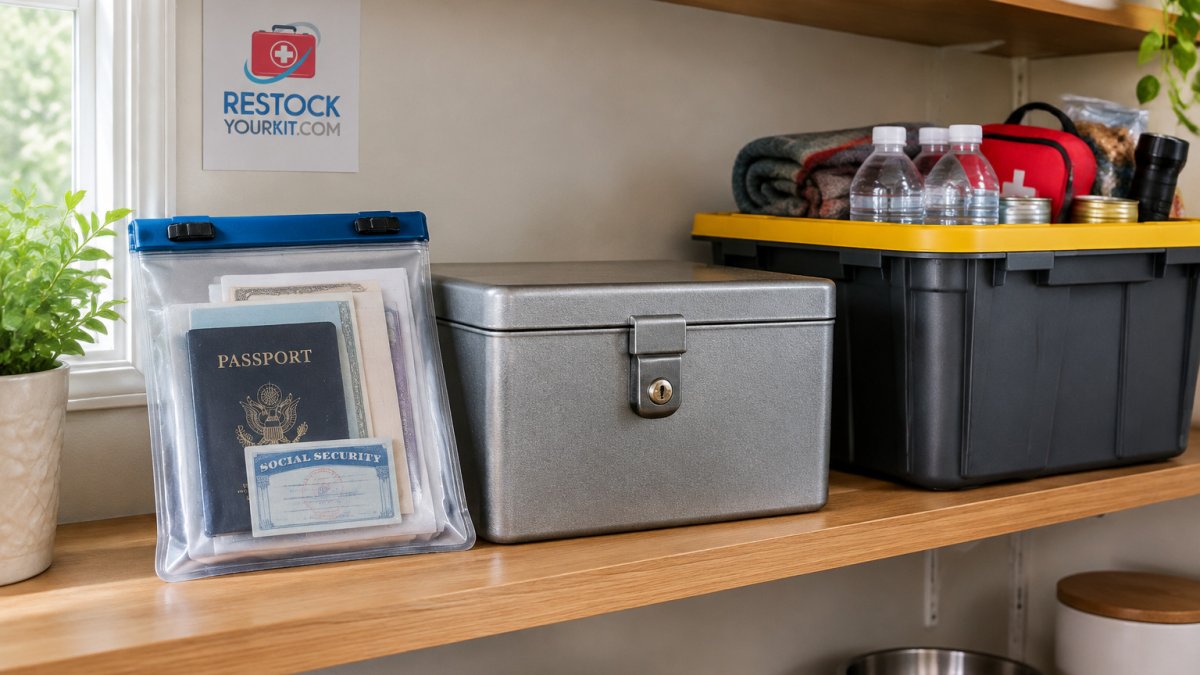
Keep originals where possible, and copies in your kit. Include: Documents poster gives a visual reminder of which identity and vital records to gather.
- Driver's license or state ID
- U.S. passport (if you have one)
- Birth certificates for each family member
- Marriage or divorce decrees
- Social Security cards or a record of your number
- Military service records, if applicable
- Green card or other immigration documents, if applicable
- Student or work identification
Replacing a lost birth certificate or passport takes time and fees. Keeping certified copies on hand in your go bag removes that delay. Store them in a waterproof pouch such as an aLOKSAK Waterproof Bag, available in a multi-pack.
Insurance, Medical, and Medication Records
Insurance and medical information matters most in the first hours after an injury or evacuation. Clinics and pharmacies often need your member ID, your medication list, and the name of your prescribing doctor before they can help.
Include copies of:
- Health, auto, homeowner's, and renter's insurance policy numbers and agent contact details
- Insurance cards (front and back)
- A current medication list with dosages and prescribing doctors
- Allergies and known medical conditions
- Vaccination records
- Emergency contact information for each family member's physician
Patient documentation can also be useful for caregivers. An Incident Report - SOAP Notes form lets you record symptoms, treatment, and observations in a consistent format, which helps when you hand off care to a professional.

Financial, Property, and Legal Papers
Money questions come up quickly after a disaster. You may need to prove ownership, request an insurance payout, or access accounts when branches are closed.
Consider keeping copies or account summaries for:
- Bank account numbers and routing numbers (store securely; never write full numbers where a thief could read them)
- Debit and credit card issuer phone numbers, so you can report losses
- Property deeds, home titles, and vehicle titles
- Current lease agreement, if you rent
- A will, power of attorney, and healthcare directive
- Recent tax returns or a list of major assets
- Pet ownership papers and microchip registration
Legal documents can be complex, and the right copy to keep depends on your situation. If your estate plan is involved, consult an attorney or check your state's resources. The U.S. Department of Homeland Security's Ready.gov site offers a checklist for assembling these records. Ready.gov checklist for important family documents
Digital vs Physical Emergency Document Storage
Physical copies work without power or internet. Digital copies are easier to update and share, but they depend on devices that can fail or be lost. The strongest plan uses both.
| Storage Method | Strengths | Weaknesses | Best Use |
|---|---|---|---|
| Paper copies in a waterproof pouch | Works without power; no login needed | Can be damaged by water or fire | Go bag, emergency kit |
| Fire-resistant safe | Protects originals from fire | Heavy; not portable | Home originals |
| Encrypted flash drive | Compact; easy to update | Needs a device to read; can be lost | Backup copy in your bag |
| Encrypted cloud storage | Accessible from anywhere | Needs internet and login; privacy risk if poorly secured | Off-site backup |
For digital copies, use strong passwords and two-factor authentication. Avoid storing unencrypted scans on shared computers. A password manager can hold login details so a family member can access accounts if you cannot.
Protecting Vital Records from Fire and Flood
Water and smoke ruin paper quickly. The goal is to keep copies dry and sealed, and to keep originals in a location that can survive the disaster you are most likely to face. Compare waterproof containers for medical supplies to find options suited to protecting important papers.
Practical steps:
- Scan or photograph every document and save copies to two separate locations.
- Seal paper copies in heavy plastic or waterproof bags. Press out air and seal fully.
- Store originals in a fire-resistant box or safe rated for paper. Check the rating label.
- Keep your go bag somewhere you can grab in under a minute, such as near an exit.
- Store the kit above ground level if flooding is a risk where you live.
Watch out: a fire-resistant safe is not waterproof, and a waterproof bag will not survive a house fire.
Building Your Emergency Go Bag Checklist
Your go bag should hold the document packet and the basics for the first 72 hours. Use this checklist to build it: Compare bulk and retail supply prices before you buy.
- Sealed document packet (copies of IDs, insurance, medications, financial summaries)
- Waterproof pouch for the packet (aLOKSAK Waterproof Bags, multi-pack)
- Individual re-closable plastic bags for smaller items
- First Aid Guide Wallet Card for quick reference in the field
- Wilderness Medicine: A Quick Reference Guide for longer outages or remote evacuations
- Personal PPE kit with N95 mask, gloves, and wipes
- Emergency glow stick for light when power is out
- A USB drive with encrypted digital copies
- Cash in small denominations and a list of emergency phone numbers
Review the packet every few months, not just once. Swap out expired medications, update addresses, and replace copies when documents renew. A simple calendar reminder keeps the kit current.
Next Step: Assemble and Schedule Your First Document Audit
Start this week. Gather the documents listed above, make copies, and seal them in a waterproof bag. Then set a recurring reminder to review the packet every three months. Our first aid kits at RestockYourKit.com can help you get the physical side in place. Shop now to build a kit you can trust when it counts.
Frequently Asked Questions
What documents should be in an emergency kit?
Keep originals or certified copies of identification such as your driver license or state ID and passport, plus birth and marriage certificates and your Social Security card. Add insurance policy numbers and card copies, a current medication list with dosages, emergency contacts, and proof of address. Financial account information, property deeds or lease agreements, and pet vaccination records round out the core set. Store everything in a waterproof, fire-resistant container and review it at least once a year.
Do I need physical copies of documents if I have digital backups?
Yes, in most cases. Digital copies are useful, but they depend on a charged device, working internet, and access to your accounts, which may be unavailable during a power outage or cell network failure. Physical copies work without any of those. A practical approach is to keep paper originals or certified copies in your kit and store encrypted scans in a cloud account and on an encrypted flash drive, so you can reach them from any device.
How often should I update the documents in my emergency kit?
Review your kit at least once a year and after any major life change, such as a move, marriage, new child, change of insurance, or a prescription change. Check expiration dates on passports and driver licenses, and replace medication lists whenever dosages change. Many people pair this review with a daily smoke detector test or a seasonal reminder, such as changing clocks, so the check becomes routine.
What financial records are essential to keep in an emergency kit?
Keep a list of bank and credit card account numbers with the issuer's customer service phone numbers, along with the routing number for your primary checking account. Include recent statements or a summary of investment accounts, and note any automatic bill payments. Keep a small amount of cash in small bills. Store this information in a sealed plastic bag, and keep the account information separate from your Social Security card to limit identity theft risk if the kit is lost.
