

What to Include in a Comprehensive Household Medical Kit
Table of Contents
- Why a Household Medical Kit Beats a Basic First Aid Kit
- The Home First Aid Kit Checklist: Core Supplies
- What Medications to Keep at Home
- Building a First Aid Kit for Families with Children
- First Aid Kit Expiration Dates and Restocking Schedule
- When to Stop Treating at Home and Seek Emergency Care
- Storing and Organizing Your Household Medical Kit
- Frequently Asked Questions
Last Updated: October 21, 2026
Why a Household Medical Kit Beats a Basic First Aid Kit
A household medical kit is a curated collection of wound care supplies, medications, tools, and protective gear stored together for use at home across the full range of everyday injuries and illnesses. A basic first aid kit handles a scraped knee.

That difference matters more than most families realize. At RestockYourKit.com, we build kits for homes, cars, and trailheads.
Here is the practical distinction. The American Red Cross first aid guidance recommends households keep supplies on hand for both minor injuries and the period before professional help arrives.
Below, we break down exactly what goes in one, how to customize it for kids and pets, and when to restock.
The Home First Aid Kit Checklist: Core Supplies
Every home first aid kit checklist starts with wound care, because cuts and scrapes are the most common household injury. Build the core around three categories: wound management, tools, and protective gear.
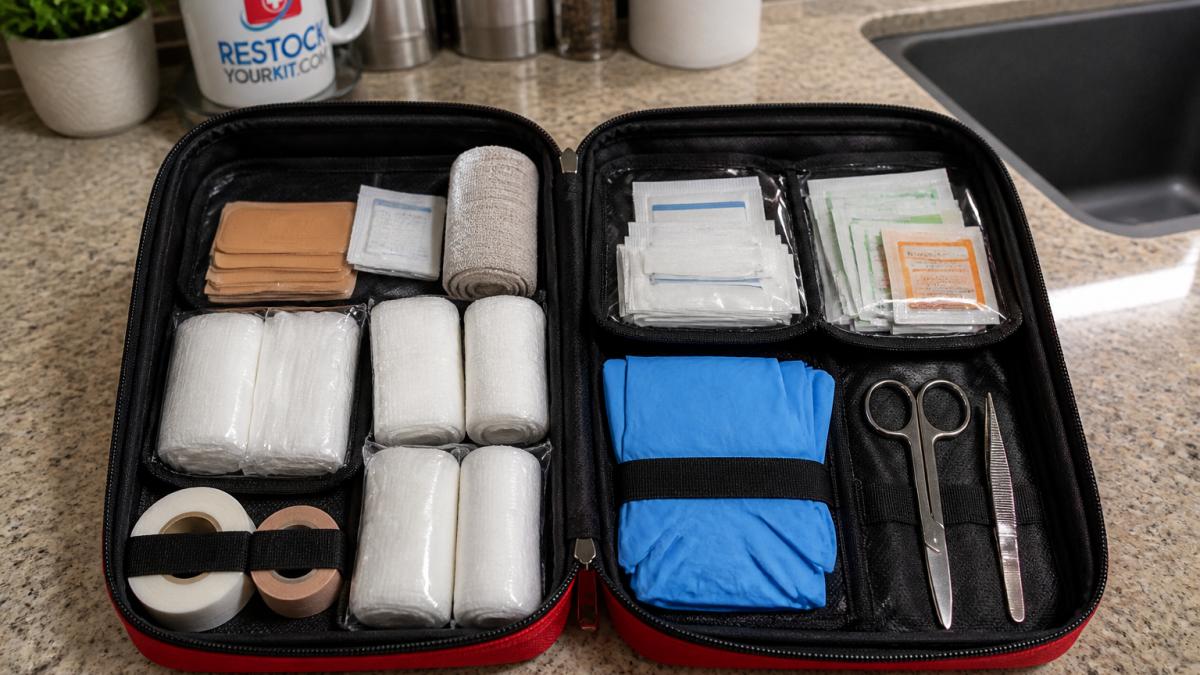
Wound Care: Bandages, Gauze, and Tape
Adhesive bandages in assorted sizes are the backbone of any kit. A pre-assembled assortment takes the guesswork out of it; our Band-Aid Assortment refill packs 24 bandages across five shapes for $4.49.
Sterile gauze pads and dressings handle what bandages cannot. Our Gauze refill kit covers all of it, including trauma pads for heavier bleeding.
Adhesive tape holds gauze in place. Hypoallergenic surgical tape is the safer default for sensitive skin.
Tools, PPE, and Emergency Gear
The items people forget are the ones that make a kit usable under pressure:
- Disposable non-latex gloves (at least three pairs)
- Scissors and tweezers (trauma shears for cutting tape or clothing, splinter forceps for splinters and ticks)
- Safety pins and cotton swabs
- Instant cold pack
- Digital thermometer
- Flashlight and extra batteries
- CPR resuscitation face shield
- Emergency shock blanket
What Medications to Keep at Home
What medications to keep at home comes down to four jobs: pain and fever, allergies, stomach upset, and skin irritation. Cover those and you handle most household situations without a midnight pharmacy run. But the difference between a useful medication stash and a hazardous one is not the list, it is how you choose, label, store, and dose what is on it.
The four core categories
- Pain and fever: acetaminophen and ibuprofen, because they work differently. Acetaminophen is processed by the liver and is the default for people who cannot take NSAIDs; ibuprofen is an NSAID and is harder on the stomach and kidneys, so it is not the right choice for everyone. Keep both, but know which is which before you need one at 2 a.m.
- Allergies and itching: a non-drowsy antihistamine for daytime and a drowsy one for nighttime reactions, plus hydrocortisone cream for rashes and bites.
- Stomach upset: an antacid for heartburn and an anti-diarrheal for travelers' stomach and stomach bugs.
- Skin irritation: sting swabs, burn gel, and hydrocortisone packets for insect bites, minor burns, and contact rashes.
A pre-built module saves time; our OTC Medication Module bundles 11 medication types for $9.99. Add a topical relief set for bites, stings, and minor burns; our Topical Relief refill includes sting swabs, burn gel, and hydrocortisone packets for $5.99.

Label, dose, and store like a pharmacist
The most common household medication mistakes are not exotic. They are double-dosing the same active ingredient under two brand names, guessing a child's dose by age instead of weight, and keeping loose pills in an unlabeled bag. A few habits prevent all three:
- Keep original packaging. The label carries the active ingredient, strength, dose, and expiration date. If you decant into a pill organizer, label the organizer with the drug name, strength, and date.
- Write the dose on the box. For each person in the household, note the correct dose for their weight or age on a piece of tape on the box. In a feverish moment, nobody wants to do math.
- Separate children's and adults' formulations. Children's liquid acetaminophen and adult tablets are not interchangeable, and the concentrations differ between brands. Store them on different shelves.
- Check for duplication. Many cold, flu, and sinus products already contain acetaminophen. Read the active ingredients before combining anything.
- Know the red flags.
A medication inventory that actually gets used
A written inventory turns a pile of boxes into a system. Tape a one-page list inside the kit lid with four columns: medication, strength, expiration date, and who in the household it is for. Update it at each inspection.
Store medications away from heat, moisture, and light, not the bathroom medicine cabinet, which cycles through steam and temperature swings. A cool, dry cabinet or a locked box in a hallway closet is a better home.
Building a First Aid Kit for Families with Children
A first aid kit for families with children needs three additions a standard kit skips: child-appropriate dosing tools, comfort items, and safety packaging. The American Academy of Pediatrics healthy children resources stress keeping medications locked and out of reach, which shapes how you store the whole kit.
Dosing tools and weight-based dosing
Children's medications are dosed by weight, not age, because two 4-year-olds can differ by 20 pounds. That makes a dosing syringe or a measuring cup marked in milliliters a more important supply than any bandage in the kit. Household spoons are not measuring devices, a kitchen teaspoon can hold anywhere from 3 to 7 milliliters, which is enough to under- or over-dose a small child.
Practical additions:
- A dosing syringe or oral syringe marked in milliliters, plus a backup cup
- Children's acetaminophen or ibuprofen, with the correct dose for each child's current weight written on the box
- A kitchen scale or a recent weight recorded on the inventory sheet, so the dose can be recalculated as the child grows
- Adhesive bandages in fun designs to reduce fear
- Instant cold packs sized for small limbs
- A written list of each child's allergies, current medications, and pediatrician's phone number
Choking, swallowing, and safety packaging
The items that help adults can hurt children. A few specifics matter more than the general advice to "keep it out of reach":
Basic Car + Home First Aid Kit →
- Avoid loose pills and small caps. Young children choke on tablets and on the small caps of essential-oil bottles and travel-size containers. Keep the medication pouch locked, not just high.
- Watch the topical products. Burn gels, sting swabs, and hydrocortisone packets are not candy, and a curious toddler can open a single-use packet in seconds. Store them in the locked pouch with the medications.
- Keep the poison control number visible. Post it inside the kit lid and on the refrigerator. In a suspected ingestion, the call is the first step, not the last.
- Separate children's supplies from adult supplies. Children's liquid formulations and adult tablets should not share a pouch, because the wrong bottle is easy to grab in the dark.
The storage trade-off
Keep the kit itself on a high shelf or in a locked cabinet. The contents should be reachable by adults in seconds and unreachable by toddlers entirely.
Recheck the kit at every well-child visit. Children grow out of doses, bandage sizes, and even fears of the kit itself, and a twice-a-year reminder tied to a pediatrician appointment is easier to remember than an arbitrary date.
First Aid Kit Expiration Dates and Restocking Schedule
First aid kit expiration dates are the most ignored part of home preparedness. Sterile supplies degrade, medications lose potency, and batteries leak. A kit you have not checked in two years is a kit you cannot trust.
Set a recurring reminder and inspect on this schedule:
| Item | Typical Shelf Life | Check Frequency |
|---|---|---|
| Adhesive bandages | 2-3 years if sealed | Every 6 months |
| Sterile gauze pads | 2-5 years if packaging intact | Every 6 months |
| Ointments and creams | 1-2 years | Every 6 months |
| Oral medications | Printed expiration date | Every 6 months |
| Batteries | 5-10 years unused | Annually |
| Gloves | 2-3 years | Annually |
Replace anything past its date, any sterile package that is torn or damp, and any medication that has changed color or consistency. Restocking individual items is cheaper than replacing a whole kit, which is why refill packs exist.
Write the inspection date on a piece of tape inside the kit lid each time you check it. Future you will thank present you.
When to Stop Treating at Home and Seek Emergency Care
Knowing when to stop treating at home is a skill, not a guess.
The CDC guidance on emergency warning signs is clear that certain symptoms warrant immediate professional help rather than home treatment.
A household medical kit buys you time. It does not replace judgment. Knowing the line between "clean it and bandage it" and "call for help" is the most important supply you can carry.
Storing and Organizing Your Household Medical Kit
Storage decides whether your kit works. Keep one kit in the kitchen or bathroom and a second in the car.
Our Basic Car + Home First Aid Kit arrives pre-sorted into category bags for $19.99, sized for 6-8 people. For a smaller everyday option, the Micro-Kit DELUXE fits in a glove box or backpack at $15.99.

Keep the kit dry, out of direct sunlight, and away from heat. Label the outside with contents and the last inspection date.
A household medical kit only protects you if it is complete, current, and findable when someone is bleeding or feverish at midnight. Start with a custom kit built around your household, set a twice-yearly inspection reminder, and replace what you use before you need it again.
Frequently Asked Questions
What supplies should every household medical kit have?
At minimum, stock adhesive bandages in assorted sizes, sterile gauze pads (2x2 and 4x4), rolled gauze, medical tape, antiseptic wipes, antibiotic ointment, hydrocortisone packets, disposable nitrile gloves, trauma shears, tweezers, a digital thermometer, and a CPR mask. Add an instant cold pack, elastic bandage, and saline for eye flushing. The Basic Car + Home First Aid Kit covers most of these for $19.99, and you can top it off with refill packs as items run low.
What medications should you keep in a home first aid kit?
Keep individually packaged doses of acetaminophen, ibuprofen, aspirin, and diphenhydramine for allergic reactions. Add an antacid, loperamide for diarrhea, motion sickness tablets, and electrolyte tablets. The OTC Medication Module - PERSONAL at $9.99 packs all of these into one resealable bag. Store medications in their original packaging with visible expiration dates, and check them every six months so you are not relying on expired doses in an emergency.
How often should you check and replace first aid kit supplies?
Inspect your household medical kit every six months and after every use. Check medication expiration dates, confirm sterile packaging is intact, and replace anything that has been opened or damaged. Most sterile items and medications last 12 to 36 months, but heat and moisture shorten that. Set a recurring calendar reminder for spring and fall, and keep a small restock list taped inside the kit so you know exactly what to reorder.
How do you customize a first aid kit for children?
Add children's acetaminophen or ibuprofen in the correct dose for your child's weight, a digital thermometer, children's bandages in smaller sizes, and a medicine syringe for measuring liquid doses. Include a copy of each child's medication list and allergy information. Keep the kit out of reach but tell older children where it is and how to call for help. A first aid kit for families with children should also include a current pediatric poison control number posted inside the lid.
What is the difference between a first aid kit and a household medical kit?
A first aid kit handles injuries: cuts, burns, sprains, and bleeding. A household medical kit goes further by adding over-the-counter medications, a thermometer, a tick removal card, electrolyte tablets, and supplies for illness as well as injury. Think of the first aid kit as the wound-care core and the household medical kit as that core plus medication, monitoring tools, and family-specific items. Building both from one base saves money and keeps everything in one place.