

Trauma Shears for Home: How to Choose the Right Tool
Quick Summary
Trauma shears have a blunt tip on the bottom blade so you can slide them under clothing against skin without puncturing it, unlike ordinary scissors. For a home kit, choose a pair with thick, stiff blades that cut denim and seat belts, a grip that works with gloves, and a blade length that fits your storage space.
- Trauma shears have a blunt tip on the bottom blade, which ordinary scissors lack.
- Choose stainless steel, or a titanium-coated pair for water sports and boating.
- The EMT Trauma Shears come in 5-1/2 and 7-1/2 inch blade sizes.
- Slide the blunt tip under fabric with the flat blade against skin, cutting away from the body.
- Wipe blades after each use, store them dry, and replace them if they bend or rust.
Table of Contents
- What Trauma Shears Are and How They Differ From Ordinary Scissors
- Blade Design, Material and Cutting Performance
- Handle Grip, Length and Ease of Use for Caregivers
- A Home-Specific Checklist for Choosing Your Shears
- How to Use Trauma Shears Safely on Clothing and Tough Materials
- Cleaning, Storing and Replacing Trauma Shears
- Building Your Home Kit Around the Shears You Choose
- Frequently Asked Questions
What Trauma Shears Are and How They Differ From Ordinary Scissors
Their defining feature is a blunt tip on the bottom blade, which lets you slide the shears under fabric against skin without puncturing it. Ordinary kitchen or craft scissors have sharp points on both blades, which makes them unsafe for that job.
The blades are also thicker and stiffer than office scissors, so they handle cutting through denim, leather and layered materials without bending. Many models have a curved or angled blade to make cutting along the body easier, and a locking or spring-action design that keeps the tool open and ready. American Red Cross first aid guidance
For a home kit, the practical question is whether the shears can do more than snip gauze. A good pair handles cutting clothing to expose a wound, removing tape and cutting through seat belts or heavy fabric, which ordinary scissors cannot do reliably. The EMT Trauma Shears are a common starting point for this kind of use.

Blade Design, Material and Cutting Performance
Blade material affects how long the shears stay sharp and how well they resist rust. The EMT Trauma Shears are listed as stainless steel.
Blade length matters as much as material. The EMT Trauma Shears are offered in 5-1/2 and 7-1/2 inch blade sizes, so you can choose the length that suits your storage space. Measure the space you plan to store the shears in before you choose.
For a coated option, the Titanium-Coated Black EMT Trauma Shears are listed at 7.5 inches. The fully coated option is listed as completely waterproof, including the pin, so it will not rust like typical shears, which makes it suited to water sports and boating. Check that the blade still has a clean, sharp edge before buying, because a dull blade pulls rather than cuts.

The article's key specifications for the two EMT trauma shears models are summarised below.
| Model | Material and finish |
|---|---|
| EMT Trauma Shears | Stainless steel |
| Titanium-Coated Black EMT Trauma Shears | Titanium-coated, black |
| Fully coated option | Completely waterproof, including the pin |
Handle Grip, Length and Ease of Use for Caregivers
The handle decides whether the shears feel steady under pressure, and for a home caregiver it also decides whether the tool is usable at all on a bad day. Look for a grip that fits a gloved hand, with rubberized or textured surfaces that stop slipping when your hands are wet or sweaty. A good handle lets you cut with one hand while holding fabric steady with the other.
A Home-Specific Checklist for Choosing Your Shears
Work through these questions before you buy:
- Will you use them only for clothing and tape, or also for heavier material?
- Do you need a blunt tip for safe cutting against skin?
- Is the blade length suited to your storage space?
- Does the handle grip well with gloves on?
- Is the blade material resistant to rust for your storage conditions?
- Can the shears be cleaned and disinfected easily?
- Do they fit your home kit's budget, with replacement cost in mind?
A common mistake is buying the cheapest pair and discovering later that it bends or dulls quickly. Spend a little more on a pair you can trust, and keep one spare if the kit is used often.
How to Use Trauma Shears Safely on Clothing and Tough Materials
Put on gloves before you start. Slide the blunt tip under the fabric with the flat side of the lower blade against the skin, then cut away from the body in short, steady strokes. Keep the blades parallel to the skin rather than angled toward it, and use your free hand to lift and steady the fabric ahead of the cut. For thick material such as denim or a heavy jacket, make several shallow passes instead of forcing one long cut, which is how blades bend and tips snap.
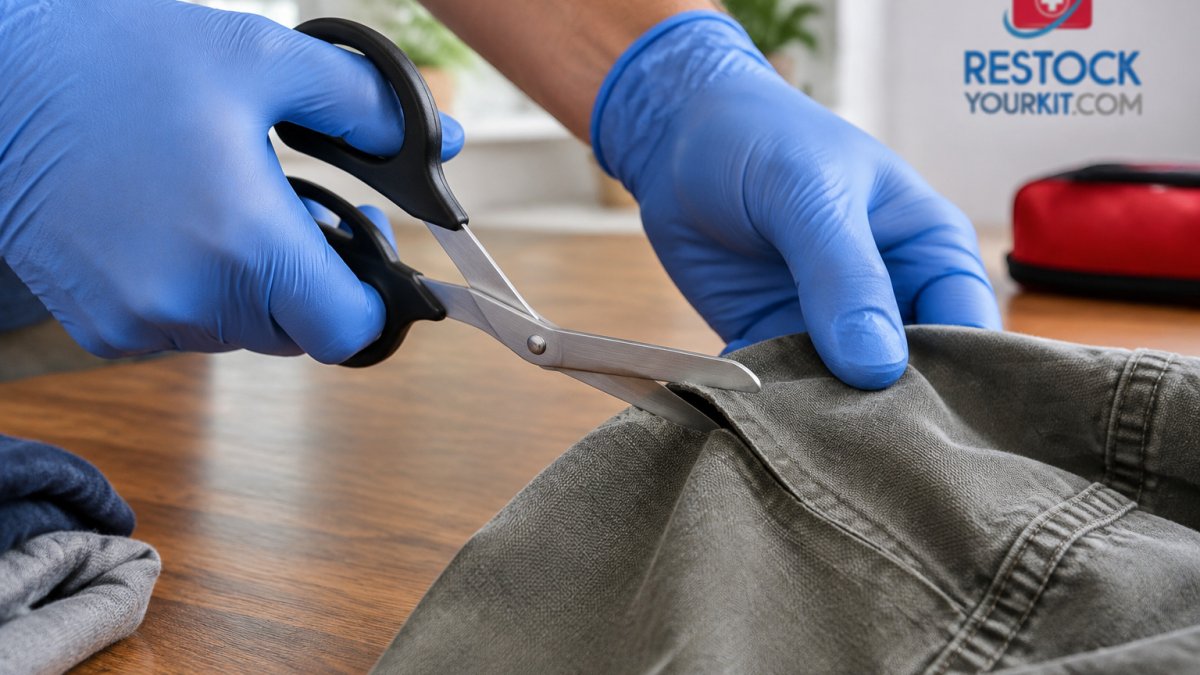
Work from the hem or seam toward the injury rather than cutting across the middle of a garment. Seams are the thickest part of most clothing, so cut alongside them, not through them, whenever you can. If clothing is stuck to a wound, do not pull it free; cut around the fabric and leave the portion adhering to the wound for a clinician to remove.
Watch out: never cut toward your own hand or toward the injured person's body, and never use the shears on metal bands, wire, or hard plastic unless the manufacturer lists those materials. Trauma shears are for clothing, tape, straps, dressings, and similar soft goods. Using them on wire or metal can chip the edge, bend the pivot, or send a fragment toward the patient.
Practice on old clothing before you need the tool in an emergency. Cut a pair of jeans, a sweatshirt, and a seat belt from a salvage yard so you learn how much force each material takes and where the blades tend to bind. Nitrile gloves, such as the Nitrile Exam Gloves (Pair), protect both you and the injured person during this work and should be part of every practice session.

Know where the tool stops and emergency care begins. Call emergency services for heavy bleeding that does not slow with direct pressure, a suspected fracture or head injury, difficulty breathing, chest pain, loss of consciousness, or any injury you are not confident you can manage. Shears are an access tool, not a treatment: they let you see and reach an injury, but they do not stop bleeding, splint a limb, or replace professional care. Keep a phone within reach and be ready to describe the injury and your location while you cut. When an injury requires more than exposing the wound, keep the focus on urgent care and consider how tactical rescue knives fit into a broader emergency-response kit.
Store the shears closed and out of reach of children between uses. A common pattern is for a household to buy a good pair, use it once, and leave it open on a counter where it dulls or gets knocked to the floor. A sheath or a dedicated pouch in the kit prevents that.
Cleaning, Storing and Replacing Trauma Shears
After each use, wipe the blades with an alcohol wipe or a disinfectant recommended for medical tools, then dry them fully. Moisture left on the blades invites rust, especially on uncoated steel. Lubricate the pivot point lightly if the manufacturer recommends it, so the blades open and close smoothly.
Store the shears in a dry place, away from heat and direct sunlight, which can damage the handles and weaken adhesives. A sealed plastic pouch inside the kit helps keep them clean. Check the blades every few months for chips, dullness or stiffness.
Replace the shears if the blades no longer close cleanly, the tips are bent, or rust has pitted the surface. A dull or damaged pair is more likely to slip and cause a new injury.
Building Your Home Kit Around the Shears You Choose
Trauma shears work best as one part of a complete kit. The Basic Car + Home First Aid Kit is a pre-assembled option that includes shears alongside gloves, bandages and gauze, which suits households that want a ready-made starting point. For a single person, the Individual First Aid Kit covers more everyday injuries in a smaller package. If you are building the kit yourself, What to Include in a Comprehensive Household Medical Kit walks through the other items most households should keep.
Pair your shears with sterile gauze, a roll of medical tape, disposable gloves and a few bandages. Check expiry dates at least twice a year and replace anything used or past its date. A kit is only as useful as its last inspection.
Frequently Asked Questions
What's the difference between trauma shears and scissors?
Trauma shears have a blunt tip to protect skin and are designed to cut through clothing, athletic tape and webbing. Ordinary scissors are designed for paper and light fabric. For a home first aid kit, trauma shears are the better choice because they can quickly remove clothing or cut tape on an injured person without causing extra harm.
What are trauma shears good for at home?
At home, trauma shears are most useful for cutting clothing away from a wound, removing tape or bandages, trimming gauze to size and cutting through seat belts or straps in an emergency. They are not a substitute for professional care. If someone has a serious injury, call 911 first and use the shears only to access the injury while you wait for help.
How do you choose trauma shears for a home first aid kit?
Look for a 5.5-inch or 7.5-inch length, stainless steel blades, a blunt tip, and a handle that is comfortable for the person most likely to use them. The EMT Trauma Shears from RestockYourKit.com start at $5.99, while the Titanium-Coated Black EMT Trauma Shears, which resist rust in damp storage, start at $17.99. Pick the length and coating that fit where the kit will be stored.
How should you clean and store trauma shears?
Wipe the blades with an alcohol wipe after each use, rinse off any blood or residue with soap and water, then dry them completely before returning them to the kit. Store them in a dry, sealed compartment away from heat and moisture. Check the pivot and blades every few months and replace the shears if they no longer cut cleanly.
