

Maintaining First Aid Kit Expiration Dates: 2026 Guide
Table of Contents
- Why First Aid Kit Expiration Dates Matter for Safety
- Step-by-Step: How to Check Your Kit for Expired Items
- Shelf Life of Common First Aid Supplies
- OSHA First Aid Kit Requirements: What Employers Must Know
- Your First Aid Kit Restocking Checklist
- Building a First Aid Kit Maintenance Schedule
- Disposing of Expired Supplies and Budget-Friendly Maintenance
- Frequently Asked Questions
Last Updated: September 11, 2026
Why First Aid Kit Expiration Dates Matter for Safety
Maintaining first aid kit expiration dates is one of those quiet tasks that feels optional until the moment it isn't. At RestockYourKit.com, we hear from families and crew leaders who discover a hardened tube of antibiotic ointment or a yellowed gauze pad only when they reach for it during an emergency.
First aid kit expiration is the practice of tracking and replacing supplies before their labeled dates pass, ensuring every item in your kit performs as intended when you need it. An expired adhesive bandage loses its stick. An expired antiseptic wipe dries out. A degraded sterile barrier means a wound dressing is no longer sterile, which is the opposite of what you want on an open cut.
The stakes are simple to understand. According to FDA guidance on drug expiration and storage, medication potency and sterility degrade over time, and products stored in heat or humidity break down faster than the label suggests. Your car kit in a hot garage ages differently than the kit in a climate-controlled closet. That single fact drives most of what follows.
Below, we'll walk through how to check your kit, what actually expires, how to build a schedule you'll stick to, and how to restock without overspending.
Step-by-Step: How to Check Your Kit for Expired Items
Checking a first aid kit takes about 15 minutes and one flat surface. Empty the entire kit, sort items into piles, and read every date code before returning anything.
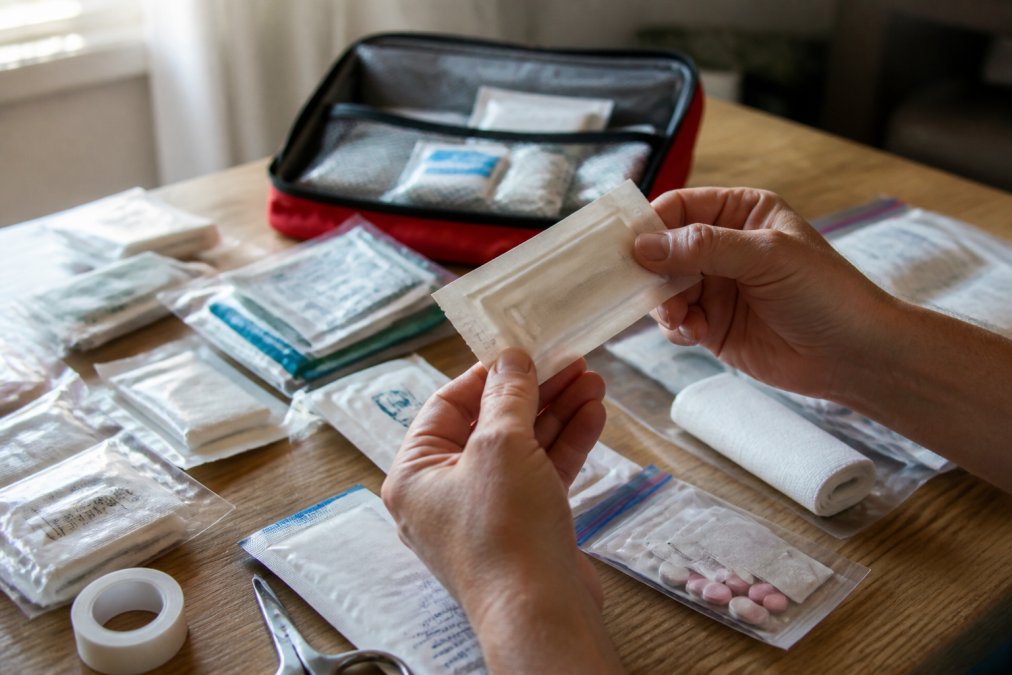
Here's the process:
- Empty the kit completely onto a clean table or counter.
- Wipe out the interior and check for moisture, dust, or melted packaging.
- Sort items into three piles: clearly in-date, questionable, and expired.
- Read date codes on every packet, tube, and bottle.
- Check seals and wrappers for tears, discoloration, or stiffness.
- Discard the expired pile and note what you removed.
- Restock what you used and what you tossed.
Sorting Supplies and Reading Date Codes
Date codes rarely sit where you expect. On medications, look for a stamped or embossed month/year on the crimped edge of a packet or the bottom of a bottle. On sterile items, the date is often printed on the sealed edge of the pouch, not the front label.
A common mistake is trusting the printed label over the actual stamp. Manufacturers sometimes apply a general label to a batch, and the true expiration is the stamped code. If you can't find or read a date, treat the item as expired and replace it.
Signs of Deterioration in Sterile Products
Sterile supplies can fail before their printed date. Watch for these signals:
- Packaging that looks puffy, damp, or discolored
- A sterile barrier with pinholes, tears, or compromised seals
- Gauze or bandages that feel stiff, brittle, or smell musty
- Ointments that have separated, hardened, or changed color
Any of these means the item has lost product integrity. Toss it, even if the date looks fine.
Shelf Life of Common First Aid Supplies
Shelf life varies widely by item and storage conditions. A kit kept in a cool, dry cabinet will outlast one baking in a car trunk. The table below gives general ranges, but the real story is what happens inside each product as it ages.
| Supply | Typical Shelf Life | Watch For |
|---|---|---|
| Adhesive bandages | 3-5 years | Loose adhesive, dried wrappers |
| Sterile gauze pads | 3-5 years | Broken sterile barrier |
| Antiseptic wipes | 2-3 years | Dried-out packets |
| Antibiotic ointment | 2-3 years | Separation, odor change |
| Oral medications | 1-2 years | Discoloration, crumbling |
| Instant cold packs | 2-3 years | Leaking or hardened pouch |
Why Shelf Life Varies: The Mechanisms Behind the Dates
Expiration dates are not arbitrary. They reflect the point at which a manufacturer can no longer guarantee that a product will perform as intended under expected storage conditions. Three mechanisms drive most first aid kit degradation:
- Adhesive breakdown. Bandage and tape adhesives are pressure-sensitive polymers that oxidize over time. Heat accelerates oxidation, which is why a bandage left in a hot car loses its stick long before the printed date.
- Moisture loss and gain. Antiseptic wipes and alcohol pads dry out when their packaging is compromised or when ambient humidity is low. Conversely, gauze and sterile packaging can absorb moisture in humid environments, which compromises the sterile barrier and encourages microbial growth.
- Chemical separation. Ointments and creams are emulsions, mixtures of oil and water held together by emulsifiers. Heat, freezing, and age cause emulsions to separate, which changes how the product spreads and how effectively it delivers its active ingredient.
- Sterility degradation. A sterile barrier is only sterile as long as it remains intact. Pinholes, creases, and seal failures, often invisible to the eye, allow microorganisms in. This is why sterile items should be inspected for packaging integrity, not just the date.
How Storage Conditions Accelerate Expiration
Storage conditions can shorten shelf life dramatically. A kit stored in a car trunk that reaches 140°F in summer will age faster than the same kit in a climate-controlled closet. The general rule: every 10°F increase in storage temperature roughly doubles the rate of chemical degradation. Humidity above 60% accelerates packaging breakdown and microbial risk. Direct sunlight degrades plastics and adhesives through UV exposure. replacing AED batteries.
Practical storage rules:
- Keep kits in a cool, dry, dark location, ideally below 77°F and under 60% relative humidity.
- Avoid garages, attics, car trunks, and bathrooms (humidity from showers).
- Use a sealed plastic bin or water-resistant bag for kits stored in vehicles or boats.
- Rotate vehicle kits more frequently, every 3 months instead of every 6.
These are general ranges. Heat, humidity, and sunlight shorten every one of them, which is why storage matters as much as the date on the box.
OSHA First Aid Kit Requirements: What Employers Must Know
OSHA first aid kit requirements do not list a universal expiration rule, but they do require that supplies be maintained and ready for use. The relevant standard, OSHA 29 CFR 1910.151 on medical services and first aid, states that adequate first aid supplies must be readily available.
In practice, that means an employer cannot leave expired or damaged supplies in a workplace kit and call it compliant. A kit with dried-out wipes and failed sterile packaging is not "adequate." Many workplaces follow the ANSI/ISEA Z308.1 standard, which classifies kits by type and class and sets minimum contents. That standard is a useful benchmark for what a compliant kit should hold, even where OSHA does not name specific items.
For workplace safety, the safest approach is a documented inspection schedule. If an inspector or a worker gets hurt and the kit fails, an empty or expired supply is a liability question you don't want to answer.
Your First Aid Kit Restocking Checklist
A first aid kit restocking checklist keeps you from buying duplicates or missing gaps. Use this one each time you audit a kit:
- Adhesive bandages in assorted sizes
- Sterile gauze pads (2x2, 4x4) and gauze rolls
- Adhesive tape and rolled bandages
- Antiseptic wipes and antibiotic ointment
- Instant cold pack
- Disposable gloves
- Tweezers, scissors, and a thermometer
- Oral medications for pain, cold, and flu
- Gastro-issue medications for nausea and diarrhea
- Emergency blanket and CPR face shield
Replace anything you used, anything expired, and anything with a compromised seal. For most households, a refill kit is a convenient way to replace items. RestockYourKit.com offers modular refill kits, including a Band-Aid assortment refill for $4.49 and a gauze refill pack, so you can top up exactly what's missing instead of rebuilding the whole kit.


Building a First Aid Kit Maintenance Schedule
A first aid kit maintenance schedule turns a one-time cleanup into a habit. The right cadence depends on where the kit lives and how often it's used.
- Home kit: full audit every 6 months
- Car kit: full audit every 3 months, given heat exposure
- Workplace kit: monthly visual check, full audit quarterly
- Crew or group kit: audit before every trip or event
- Backpacking kit: audit before each outing and after each use
The logic is exposure. A kit in a hot vehicle or a humid garage ages faster, so it earns more frequent checks. A kit in a climate-controlled hall closet can go longer between full audits.
Setting Up Reminders and Digital Tracking Tools
Paper logs work, but they get lost. Digital tracking tools solve the forgetting problem that most people describe when they build a custom kit. A shared calendar reminder set six months out, a note in your phone with the audit date, or a simple spreadsheet with columns for item, date added, and expiration does the job.
For families and crews, a shared digital list is the most reliable option. Everyone can see what's running low, and whoever restocks can update the log in seconds. The goal isn't a perfect system. It's a system you'll actually use.
Disposing of Expired Supplies and Budget-Friendly Maintenance
Disposal depends on what you're throwing away, and getting it wrong creates problems for both the environment and your household. Expired adhesive bandages, dried-out wipes, and non-medicated supplies can go in regular trash. Medications are different. According to FDA guidance on medication disposal, many medications can be mixed with an undesirable substance like used coffee grounds or cat litter, sealed in a container, and placed in the trash, while others should go to a drug take-back location. Never flush medications unless the label specifically says to.
Reducing the Environmental Impact of Disposal
Most guides stop at "throw it in the trash." That advice is safe but not sustainable, and it misses a real opportunity to reduce waste. Here's how to dispose of expired supplies more responsibly:
- Separate by material type. Cardboard boxes, paper inserts, and non-contaminated plastic packaging can go in recycling. Contaminated items, used gauze, opened ointment tubes, anything that touched a wound, go in the trash.
- Use drug take-back programs. Many pharmacies, hospitals, and law enforcement offices host permanent take-back kiosks. The DEA drug take-back locator lists collection sites by ZIP code. These programs incinerate medications under controlled conditions, which keeps them out of landfills and waterways.
- Avoid flushing unless directed. Wastewater treatment plants are not designed to remove pharmaceutical compounds, and trace amounts have been detected in waterways. The FDA maintains a short "flush list" of medications that are safe to flush only when take-back is not available, most first aid kit items are not on it.
- Consolidate before you toss. If you're replacing a full kit, check whether a local shelter, community center, or animal rescue accepts unopened, in-date supplies. Many do, and it keeps usable items out of the waste stream.
- Choose refillable formats where possible. Buying refill modules instead of whole new kits reduces packaging waste and is usually cheaper per item.
Budget-Friendly Maintenance Habits
Budget-friendly maintenance comes down to four habits:
- Buy refills instead of whole new kits. A refill module typically costs a fraction of a full kit and lets you replace only what's missing.
- Rotate older stock to the front. When you restock, move older in-date items to the front of the kit so they get used first. This is the same first-in, first-out principle grocery stores use, and it cuts waste significantly.
- Store kits away from heat, sunlight, and humidity. Every degree of heat and every point of humidity shortens shelf life, which means more frequent replacements and higher long-term cost.
- Audit on a schedule, not on a whim. A 15-minute audit every six months catches expirations before they pile up, so you're replacing a few items at a time instead of a whole kit at once.
RestockYourKit.com stocks individual quantities at near-wholesale prices, so you can replace a handful of items without buying a full kit. Free shipping applies on orders of $79 or more, which offers a convenient way to combine a restock with cold and flu or gastro-issue refills.
Frequently Asked Questions
Can you still use an expired first aid kit?
It's not recommended. Expired items may lose potency or sterility, making them less effective or even harmful. For example, expired antiseptic wipes can dry out, and sterile gauze can become contaminated. Instead of risking it, replace expired supplies promptly. Regular checks of first aid kit expiration dates keep your kit reliable.
What is an OSHA requirement for first aid kits?
OSHA requires employers to provide first aid supplies that are readily available and properly maintained. While OSHA doesn't specify expiration dates, it mandates that supplies be in sanitary and usable condition. This means regularly checking and replacing expired items. Keeping a maintenance log helps demonstrate compliance during inspections.
How often should you inspect and restock your home first aid kit?
Inspect your home kit every six months and restock as needed. Check expiration dates on medications, antiseptic wipes, and sterile supplies. Also look for signs of damage like torn packaging. If you use your kit frequently, consider more frequent checks. A first aid kit maintenance schedule ensures you're always prepared.
How do you properly dispose of expired medical supplies?
Disposal depends on the item. Expired medications should be taken to a drug take-back program or mixed with undesirable substances and thrown in the trash. Expired sterile supplies can go in regular trash unless contaminated with blood or bodily fluids, then follow biohazard rules. Check local guidelines for medical waste.