Cart
0
You open your first aid kit to grab a bandage and the zipper catches on a crumpled wrapper. Half the packets are empty, the tape roll is a cardboard core, and the meds have dates that look like ancient history. That’s not a character flaw - that’s what happens when a kit actually gets used.
If you want a kit you can trust on a scout outing, a boat, a road trip, or a remote trailhead, restocking has to be a repeatable process. The goal is not to build a museum-quality kit. The goal is to restore capability fast: bleeding control works, infection prevention is covered, pain and allergy meds are current, and you can manage the common stuff without dumping everything onto the ground.
How to restock a first aid kit without overthinking it
Restocking goes best when you treat it like a quick maintenance check, not a shopping spree. You’re going to answer three questions: what got used, what expired, and what doesn’t match the way you travel now.
Start by setting a timer for 30 minutes and clearing a small workspace. If your kit supports a group, grab a second person - one reads labels and dates while the other sorts.
Empty the kit completely. Don’t “peek and top off.” Full dump-outs are how you find the missing trauma shears, the opened sterile gauze, and the glove packet that got punctured by a safety pin.
Step 1: Sort into “replace,” “restock,” and “upgrade”
As you empty the kit, make three piles.
The replace pile is anything that’s expired, opened, contaminated, wet, crushed, or missing key parts. The easy calls are opened sterile items (gauze pads, non-adherent pads, irrigation syringes) and anything with compromised packaging.
The restock pile is anything you used and want again in the same form. If you used six adhesive bandages and two blister pads on your last trip, that’s not a failure - that’s data.
The upgrade pile is where you put items that technically function, but don’t function well for your real use case. That might be drugstore tape that won’t stick when you’re sweaty, tiny scissors that can’t cut clothing, or bulky retail bottles that don’t belong in a compact kit.
Step 2: Do the fast safety check (sterility and PPE)
Before you think about meds, make sure the kit still protects you while you’re helping someone else.
Check gloves first. If the glove packets are brittle, torn, or missing, replace them. For most kits, multiple pairs beats a single pair. If you’re running a crew kit, add enough for more than one patient and more than one rescuer - gloves get ripped, and you don’t want to ration PPE.
Next, check anything labeled sterile. If it’s opened or compromised, it’s out. Sterile dressings are not “probably fine.” They’re either sealed and intact or they’re training supplies.
Then confirm you still have a way to irrigate and clean wounds. The most common restock miss we see in field kits is having plenty of gauze but no practical way to flush grit out of a cut.
Step 3: Audit medications by date and by mission
Medication restocking is where kits quietly fail. Not because people forget pain relievers - because they forget that medications are perishable, travel-specific, and often used faster than expected.
Pull all meds into one place and check expiration dates one-by-one. If you carry individually packaged OTC meds, this is quick and clear. If you carry loose tablets in tiny baggies, it’s slower, and you’re more likely to end up with mystery pills you can’t confidently identify. When in doubt, replace.
Now match meds to who the kit supports.
For family and group kits, it “depends” on ages, allergies, and medical history. Kids change dosing needs fast. Adults on blood thinners change your bleeding-control plan. Someone with known anaphylaxis changes everything - and that’s where prescription items and a written emergency plan belong, not guesswork.
Also match meds to the season. Flu season means you’ll burn through fever reducers and sore throat support quickly. Tick season means you’ll use more skin care, antiseptics, and fine-tip tweezers than you think.
Finally, check packaging durability. Foil packets that are creased and punctured should be replaced even if the date is good.
Step 4: Rebuild the kit around the top five problems
Most real-world kit use clusters around a few categories. When you restock, prioritize these first, then fill in the niche items.
1) Bleeding and wound coverage. Restock the items you actually reach for: adhesive bandages in a few sizes, gauze pads, rolled gauze, and something that can hold a dressing in place. If your kit is for remote travel or you’re responsible for a crew, add heavier bleeding control capacity and make sure you can access it quickly.
2) Blisters, hot spots, and tape. For hiking and scouting, blister care is not optional. Restock blister pads or moleskin-style coverage and make sure your tape is the kind that stays put when wet. If you used it last trip, double it.
3) Cleaning and irrigation. Antiseptic wipes are convenient, but they don’t replace flushing. Restock irrigation tools and supplies that let you clean a wound effectively without burning through your entire water bottle.
4) Pain, fever, allergy, and GI. You’ll often use these more than anything else. Restock based on group size and trip length, not based on what fits in the lid pocket.
5) Tools and “can’t improvise” items. Trauma shears, tweezers, a thermometer for family kits, and a CPR barrier if you carry one. These are the items people borrow and forget to return.
Step 5: Right-size quantities (home kit vs. day pack vs. crew kit)
Restocking gets expensive when you try to make one kit do every job.
A home kit can support more bulk: larger bottles, extra wraps, duplicate tools. A day pack kit should be lean and fast, built around immediate stabilization and the most common trail problems. A crew or expedition kit needs redundancy, more PPE, and quantities scaled to the number of people, not the size of the bag.
If you’re leading a group (Scouts, a boat crew, a trip with two vehicles), modular packing is the cleanest solution. Keep a core kit, then add small refill modules: meds, wound care, blister care, and PPE. When one module gets raided, you restock that module only instead of rebuilding your whole kit.
Step 6: Pack for speed and keep the “use-first” items visible
How you repack matters as much as what you buy.
Put gloves and bleeding-control up front. Put the items you use constantly (bandages, tape, blister care, antiseptic wipes) in the easiest pocket to reach. Put the “nice-to-have but not urgent” items deeper.
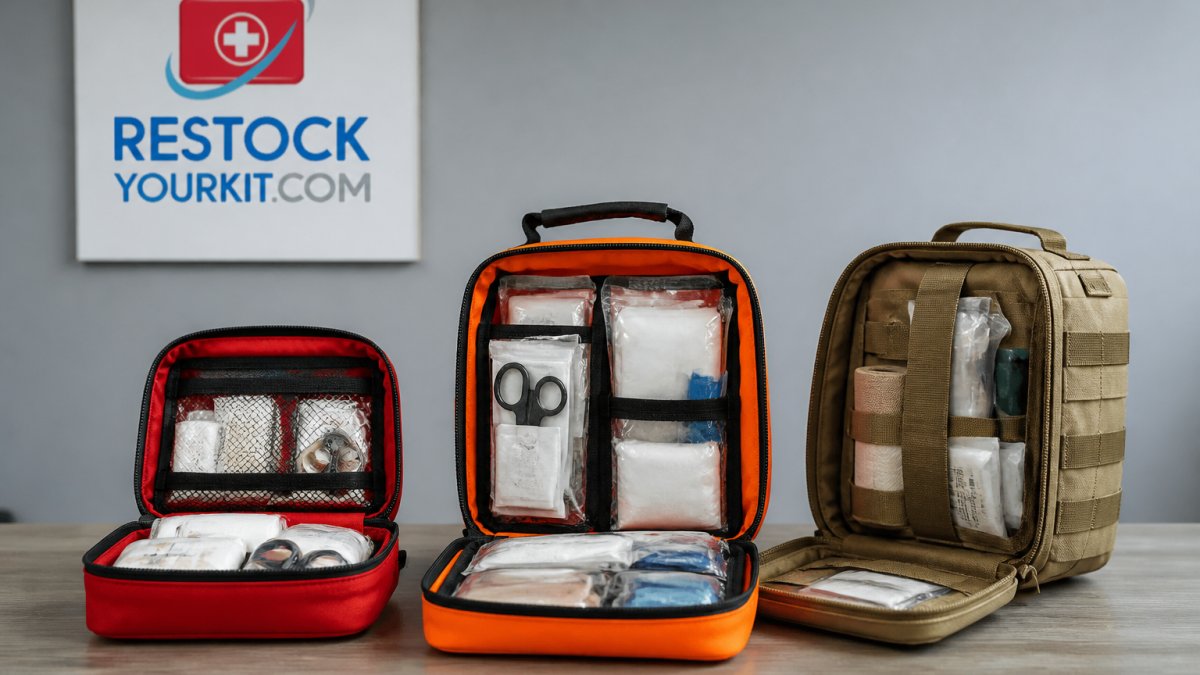
Keep like-with-like. Loose packets floating around feel compact until you need something in the rain. If your kit has internal pouches or elastic organizers, use them. If it doesn’t, consider adding small internal bags so meds don’t migrate into the bottom corners.
Step 7: Create a restock trigger, not a resolution
The easiest way to stay ready is to stop treating restock like an annual event. Use triggers.
Restock after any trip where you opened more than a couple items. Restock at the start of flu season. Restock when you swap out seasonal gear (winter layers in, summer kit out). And do a date check twice a year - it takes five minutes if you keep meds organized.
If you manage multiple kits (home, car, boat, packs), label them with a small piece of tape and a month: “Check meds - March/September.” It’s low-tech and it works.
Common restocking mistakes we see in the field
The first is replacing what looks missing, not what was used. If you used all your non-adherent pads and never touched the triangular bandage, that’s telling you something about the injuries you’re actually managing.
The second is carrying one of everything and enough of nothing. A kit with three different antiseptics and four bandages is not ready for a scraped knee that turns into a full lower-leg dressing.
The third is assuming your kit is “good” because it’s full. Expired meds, punctured foil packets, and opened sterile gauze all count as empty when it matters.
The fourth is neglecting comfort and compliance items. If you’re caring for kids, Scouts, or nervous adults, gloves that fit, tape that doesn’t rip skin, and dressings that stay in place are not luxuries. They’re what make your care plan doable.
Where modular refills make restocking faster
If you like the idea of a kit that stays consistent, modular refills are the closest thing to a cheat code. When you treat your kit like a set of repeatable “lanes” (PPE lane, meds lane, wound lane, blister lane), you stop doing random convenience-store substitutions.
That’s also where a preparedness-first shop like RestockYourKit.com fits naturally: small-quantity, individually packaged supplies and refills let you top off exactly what you used without buying a whole new kit just to get three items back.
Restocking still requires judgment, though. If your last season included more backcountry miles, more boat days, or more people under your care, you may need to upgrade capacity, not just refill.
A final thought to keep you honest
Restock your kit the same day you restock your fuel can and recharge your headlamp battery: while the trip is still fresh and you can remember what you reached for first. Your future self, standing in the wind with a cut hand and fading daylight, will not care how neatly you packed it. They’ll care that it works.