

What Is the Best Tick Repellent Spray for Families?
Last Updated: October 25, 2026
Quick Summary
The best tick repellent spray for families pairs a picaridin skin spray, which repels ticks up to 8 hours without damaging gear, with a permethrin clothing spray that lasts up to 42 days on fabric. Match the format to the child: lotion for toddlers, pump spray for school-age kids, towelette for teens.
- Higher DEET concentrations extend protection time, not strength, per EPA guidance.
- Picaridin repels ticks up to 8 hours and mosquitoes up to 14 hours.
- Permethrin goes on clothing, tents, and packs, never on skin.
- Treat label protection hours as a ceiling and reapply after swimming or toweling off.
- Never let a child apply repellent themselves; spray your hands first, then rub onto their skin.
Table of Contents
- How We Chose the Best Tick Repellent Sprays for Families
- The Best Tick Repellent for Kids: Age Guidance and Product Picks
- DEET vs. Picaridin for Ticks: Which Active Ingredient Fits Your Family?
- How Long Tick Repellent Lasts in Real Outdoor Conditions
- Permethrin Clothing Treatment for Ticks: The Layer Most Families Skip
- Safe Application: Skin Sprays, Clothing Treatments, and Label Directions
- Build a Family Tick Kit Before Your Next Hike or Camping Trip
- Frequently Asked Questions
How We Chose the Best Tick Repellent Sprays for Families
Finding the best tick repellent sprays for families starts with one hard truth: no single spray covers every family member and every situation.
We did not rank on marketing claims. For broader seasonal preparation, see our guide on how to prepare for tick season.
A common mistake is buying one product and assuming it covers skin, clothing, and toddlers. It rarely does. Below, we show you exactly how each type fits, and which ones earn a spot in your pack.
The Best Tick Repellent for Kids: Age Guidance and Product Picks
Most repellent guides tell you which ingredient works. Few tell you which product to hand a parent of a two-year-old versus a parent of a twelve-year-old.
Start with the ingredient rules, then match the format to the age.
Infants under two months: The American Academy of Pediatrics guidance on insect repellents advises against DEET on infants under two months. For a baby in a carrier or stroller, the practical answer is physical barriers first, treated clothing and gear second, and skin repellent only on exposed skin per label directions. Oil of lemon eucalyptus is not for children under three.
Toddlers and preschoolers (roughly 2 to 5): This is the age where format matters as much as ingredient. Our pick here is the picaridin tick and insect repellent lotion: it repels ticks for up to 8 hours and mosquitoes up to 14, and the lotion lets a caregiver place product precisely on arms, legs, and neck without a mist cloud near the face.

School-age kids (roughly 6 to 12): Independence rises and so does time in tall grass, camp, and woods. The picaridin tick and insect repellent spray pump covers ticks up to 8 hours and mosquitoes up to 14, carries a lighter odor than DEET, and will not degrade plastic water bottles, sunglasses, or synthetic straps in a packed daypack.

Teens and adults: Duration and gear compatibility become the deciding factors. A higher-concentration DEET product can hold longer on a full backcountry day, while picaridin remains the better everyday choice for families sharing gear.
The caregiver layer: Whatever the age, treat clothing with permethrin before the trip. The permethrin clothing tick and insect repellent spray goes on fabric, tents, and packs, lasts up to 42 days of sun exposure or six or more washings, and is odorless once dry.

Best for: parents who want a skin repellent they can apply precisely to younger kids. Skip if: your child will be in water or heavy sweat, where reapplication becomes the priority and a towelette or pump spray is easier to reapply mid-trip.
DEET vs. Picaridin for Ticks: Which Active Ingredient Fits Your Family?
Both DEET and picaridin repel ticks. The practical difference comes down to feel, smell, and what each does to your gear.
DEET is the long-studied standard, and higher concentrations extend protection time rather than strength. The EPA guidance on DEET and repellent registration notes that concentration affects duration, not how well the ingredient works.
That last point is not minor. DEET can degrade watch crystals, camera bodies, and synthetic straps. Picaridin will not. For families with a lot of gear in one bag, that tilts the decision.
For a skin-applied picaridin spray, the picaridin tick and insect repellent spray pump is our top pick.
Best for: families who want strong tick protection without gear damage. Skip if: you need maximum-duration protection for a full backcountry day, where a higher-concentration DEET product may hold longer.
How Long Tick Repellent Lasts in Real Outdoor Conditions
Label protection times are measured under controlled conditions. A hike adds sweat, humidity, water crossings, abrasion from a pack strap, and hours in tall grass, and each one shortens how long a repellent keeps working. The useful skill for families is not memorizing a number but reading the conditions and reapplying before protection lapses.
Here is what actually shortens a protection window:
- Sweat and humidity dilute and physically move product off skin. A hot, humid afternoon is the fastest way to burn through a labeled window.
- Water removes most skin repellents. Swimming, wading, and stream crossings reset the clock, and so does toweling off.
- Abrasion from pack straps, clothing, and car seats wears product off high-contact areas like shoulders, the waistband, and behind the knees, which are also tick hot spots.
- Sun and heat degrade some formulations faster than a label assumes, especially on gear left in a hot car.
As a working rule, treat label hours as a ceiling, not a promise. Reapply per the product label, and always after swimming or toweling off. On a heavy-sweat day, plan to reapply sooner than the label suggests rather than waiting for the stated hour to arrive.
Picaridin Tick + Insect Repellent Spray Pump (4 oz.) →
Here is how the options we recommend compare:
| Product | Active Ingredient | Tick Protection | Best Use |
|---|---|---|---|
| Picaridin Spray Pump (4 oz.) | Picaridin | Up to 8 hours | Skin, whole family |
| Picaridin Lotion (4 oz.) | Picaridin | Up to 8 hours | Skin, precise application for kids |
| Permethrin Clothing Spray (12 oz.) | Permethrin | Up to 42 days on treated gear | Clothing, tents, packs |
| BugX30 Towelette | DEET | 7+ hours | Single-use, on-the-go touch-ups |
The BugX30 towelette is the practical answer for a glove box or daypack. It delivers more than 7 hours of protection in a water-based, non-greasy formula, and the single-use format means no half-empty bottle leaking in a bag.
For families, the practical takeaway is to build reapplication into the trip plan: a skin repellent in the pack, a towelette for touch-ups, and permethrin-treated clothing as the layer that does not need reapplying during the day. Pairing these protective measures with a lightweight sunscreen for sensitive skin ensures that your family remains shielded from both biting insects and harsh ultraviolet rays throughout the day.
Permethrin Clothing Treatment for Ticks: The Layer Most Families Skip
Treating clothing with permethrin is the most underused tick defense available to families. Unlike skin repellents, permethrin is applied to fabric and gear, where it repels and kills ticks on contact rather than waiting for them to reach skin.
The permethrin clothing tick and insect repellent spray is designed for clothing, tents, sleeping bags, and packs. A single application lasts up to 42 days of sun exposure or six or more washings, and it is odorless once dry. It is registered for use by the U.S.
The rule families get wrong: permethrin goes on gear, never on skin. Treat clothes and let them dry fully before wearing. Pair treated clothing with a skin repellent and you have two independent layers of protection.
Safe Application: Skin Sprays, Clothing Treatments, and Label Directions
Safe use comes down to three habits: read the label, apply to the right surface, and supervise kids.
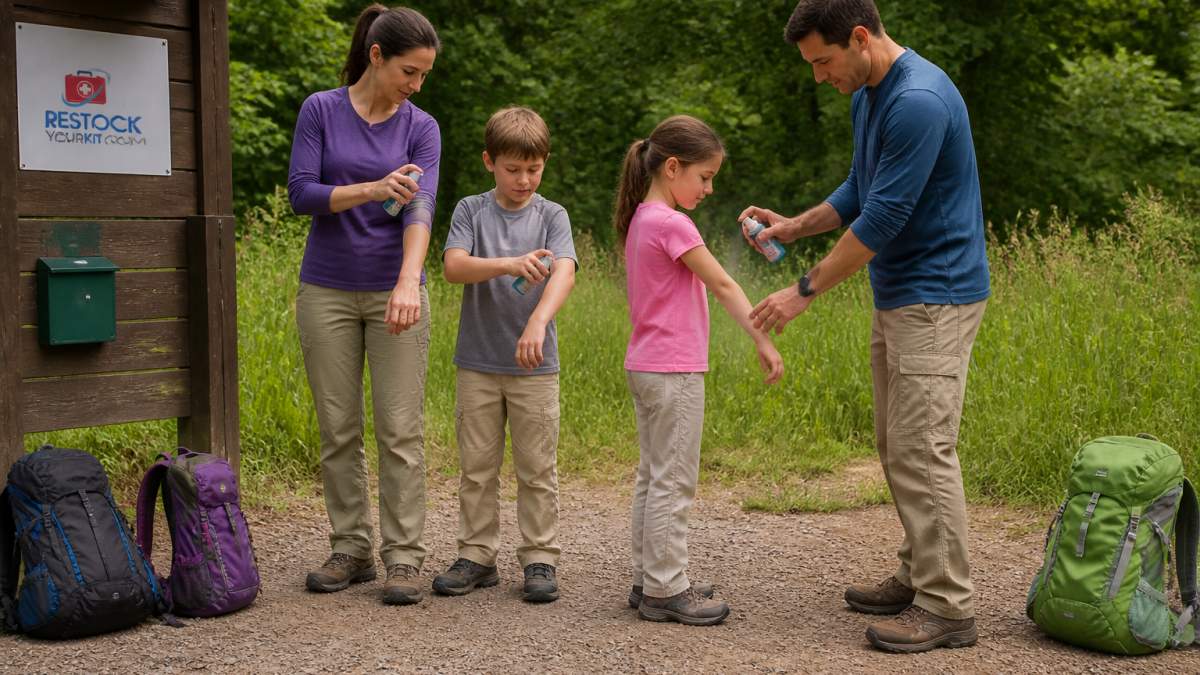
For skin sprays, apply to exposed skin only, avoid cuts and the face, and spray in an open area rather than a closed room. For children, spray your own hands first, then rub onto their skin.
For clothing treatments, apply outdoors, let gear dry completely, and keep treated items away from pets and food prep areas until dry. Wash treated clothing separately from untreated laundry.
Watch out: spraying permethrin directly on skin or applying DEET under clothing can cause irritation and defeats the purpose of layered protection. Follow the product label every time, and store repellents out of reach of children.
Build a Family Tick Kit Before Your Next Hike or Camping Trip
A tick kit turns panic into a five-minute routine. The goal is to remove a tick fast, protect the bite site, and know what to watch for afterward.
Build yours around these items:
- Fine-tipped tweezers for removal
- Skin repellent for the whole family
- Permethrin-treated clothing or a treatment spray
- Antiseptic wipes and adhesive bandages
- A small container to save the tick for identification
- A tick removal guide and symptom checklist
- A written record of the bite date and location
If you would rather start from a ready-made option than assemble one item by item, a tick safety kit covers the removal and aftercare basics in one purchase. For broader seasonal prep, our guide on how to prepare for tick season walks through the full checklist beyond the trail.
After any outdoor day, do a full-body tick check, focusing on scalp, ears, armpits, waistband, and behind the knees (the CDC). Shower soon after coming inside, and tumble clothes in a hot dryer to kill any ticks still clinging.
Frequently Asked Questions
What is the most effective tick repellent spray for families?
There is no single winner because it depends on who is wearing it and where. For skin, a picaridin spray like the Picaridin Tick + Insect Repellent Spray Pump ($13.49) repels ticks for about 8 hours and is gentle on gear and clothing. For clothes and packs, a permethrin clothing treatment ($18.99) kills ticks on contact and lasts up to 42 days of sun exposure or 6+ washings. Most families get the best coverage by pairing a skin spray with a clothing treatment.
Which is safer for kids, picaridin or DEET?
Both are registered with the U.S. EPA and considered safe when used according to the label. Picaridin has a low citrus odor, is non-greasy, and will not damage plastics or synthetic fabrics, which many parents prefer for young kids. DEET has a longer track record and works well, but it can damage some plastics and gear. For children, follow the label's age guidance, apply to exposed skin only, and avoid the hands and face.
Can you use permethrin spray on skin?
No. Permethrin is a clothing and gear treatment only. Spray it on clothing, tents, sleeping bags, and backpacks, then let it dry completely before wearing. It is odorless after drying and will not stain fabrics. For skin, use a separate repellent like picaridin or DEET. Combining a skin spray with permethrin-treated clothing gives you the most complete tick protection.
How long does tick repellent spray last?
Protection duration depends on the active ingredient and conditions. The Picaridin spray and lotion from RestockYourKit.com repel ticks for about 8 hours and mosquitoes up to 14 hours. The BugX30 towelette provides 7 hours of continuous protection and is water and sweat resistant. Permethrin clothing treatment lasts up to 42 days of sun exposure or 6+ washings. Reapply skin repellents after swimming, heavy sweating, or the labeled time window.
Should children use the same tick repellent as adults?
Children can use the same active ingredients as adults, but application matters more. Apply repellent to your own hands first, then rub it onto your child's exposed skin, avoiding hands, eyes, and mouth. Check the product label for any age restrictions. For kids who resist sprays, a lotion like the Picaridin Tick + Insect Repellent Lotion ($13.49) gives the same 8-hour tick protection with easier, more controlled coverage.
Tick season does not wait for a convenient weekend, and neither should your prep. RestockYourKit.com stocks family tick repellents, permethrin clothing treatment, and modular first aid supplies at near-wholesale prices, with free shipping on orders of $79 or more. Build a kit around your family's real routines and restock it before the season starts. Get started with RestockYourKit.com and keep every hike, campsite, and backyard afternoon covered.
