

MFASCO Alternative for Small Farms: Better Kits
Table of Contents
- Why Small Farms Outgrow MFASCO
- MFASCO Alternative for Small Farms: What to Compare
- OSHA Compliant First Aid Kits for Agriculture: The Real Rules
- Your Farm First Aid Kit Checklist: People and Livestock
- Fast Comparison: Farm Supply Vendor Options
- Bulk Medical Supply Refills Without the Bulk Pricing
- Which Small Farm Kit Setup Fits Your Operation?
- Conclusion: Stock Smart, Not Just Stocked
- Frequently Asked Questions
Last Updated: September 8, 2026
Why Small Farms Outgrow MFASCO
Most small farm operators start with a single bulk first aid kit from an industrial supplier, then realize within a season that it doesn't fit how they actually work. The kit has 200 adhesive bandages and zero poultry supplies, no livestock wound care, and nothing designed for the specific injuries that happen around fencing, equipment, and animal handling.

An MFASCO alternative for small farms makes sense when your operation diversifies beyond a single enterprise. Adding a chicken flock, a few goats, or a market garden splits your safety needs into categories generic industrial kits never address: people care, livestock care, and specialty supplies for small-scale production.
This pattern repeats with backyard poultry keepers and small acreage operators. A farm first aid kit checklist that works for a 40-acre row crop operation doesn't translate to a diversified homestead where you're treating a dog bite one hour and a bumblefoot case the next. The real question isn't whether you need better supplies, it's whether you need a fundamentally different sourcing approach.
MFASCO Alternative for Small Farms: What to Compare
Choosing an MFASCO alternative for small farms comes down to four factors that matter more than brand loyalty: pricing structure, minimum order requirements, inventory freshness, and whether the vendor understands agricultural use cases. Industrial medical suppliers serve warehouses and factories, not farms, and that orientation shows up in what they stock and how they sell it.
Vendor Pricing and Minimum Order Requirements
Industrial suppliers often require volume purchases that don't make sense for a 20-bird flock or a family market garden. When you need one tube of antibiotic ointment, not a case of 24, the per-unit savings disappear against the waste of expired product.
Look for vendors that sell individual quantities at near-wholesale prices. This matters for small farms because your consumption rate is unpredictable, and buying in bulk you'll never use is false economy.
Inventory Freshness and Expiration Dates
A first aid kit with expired medications is a false sense of security. Industrial supply chains often warehouse product for months before it reaches you, which means you lose shelf life before the kit even arrives.

Vendors that build kits to order rather than stocking pre-assembled units typically ship fresher product.
OSHA Compliant First Aid Kits for Agriculture: The Real Rules
Most farm operators assume OSHA compliance means buying a specific kit with a specific label. That assumption is wrong, and it can cost you in a citation or, worse, in an emergency response failure. The actual regulatory framework is more nuanced, and understanding it is the difference between a kit that passes an inspection and one that actually saves a life.
The Performance-Based Standard
OSHA's core requirement, found in 29 CFR 1910.151(b), states that employers must ensure "the ready availability of medical personnel for advice and consultation on matters of plant health (osha.gov)." When medical personnel are not readily available (which is the case for most farms), the employer must provide "a person or persons adequately trained to render first aid" and "adequate first aid supplies."
The key phrase is "adequate." OSHA does not define what constitutes adequate supplies in the regulation itself. Instead, the agency defers to the American National Standards Institute (ANSI) standard Z308.1, which specifies minimum contents for first aid kits based on the number of employees and the types of hazards present. For agricultural operations, OSHA's Field Operations Manual directs compliance officers to evaluate whether the kit contents are "appropriate for the hazards present", not whether they match a generic checklist.
The Agricultural Exemption You Should Know
Farms with fewer than 11 employees are exempt from OSHA's general industry standards under the appropriations rider that has been in effect since 1976 (osha.gov). This means OSHA cannot conduct routine inspections or issue citations for first aid violations on small farms. However, this exemption does not apply if you have workers' compensation claims, if you are part of a larger corporate structure, or if you have been cited for a serious violation in the past.
More importantly, the exemption does not remove your liability. If a worker is injured and you lack adequate supplies, you face civil liability, workers' compensation disputes, and potential state-level enforcement. Many states (including California, Washington, and Oregon) have their own agricultural safety programs that are stricter than federal OSHA and do not have the small-farm exemption.
What "Adequate" Means in Practice
For a small farm with 2-10 employees, the practical interpretation of "adequate" requires:
- A written hazard assessment, Document the specific risks on your operation: machinery, livestock, chemicals, heights, heat stress, and zoonotic diseases.
- A physician-approved supply list, OSHA requires that supplies be approved by a consulting physician. This does not mean a prescription; it means a signed document from a licensed physician (often your local clinic or a telemedicine service) stating that your kit contents are appropriate for your identified hazards.
- Training documentation, If you have more than one employee, at least one person must be trained in first aid and CPR. Keep certificates on file.
- Accessibility and response time, Kits must be reachable within 3-4 minutes of any work area (osha.gov). For a farm with multiple buildings or fence lines, this means multiple kits, not one central cabinet.
The Documentation Trap
Most farm operators fail not because they lack supplies, but because they lack documentation. An OSHA inspector (or a plaintiff's attorney) will ask three questions: What are your hazards? What supplies do you have? How did you decide those supplies match those hazards? If you cannot produce a written assessment and a physician's sign-off, your compliance is presumed inadequate regardless of what is in the kit.
Building a Defensible Kit
For most small farms, the defensible approach is:
- Conduct a written hazard assessment (a one-page document is sufficient).
- Select supplies that address those specific hazards, not a generic 200-piece kit.
- Have a local physician or your state's cooperative extension service review and sign the supply list.
- Post the assessment and the physician's approval inside the kit lid.
- Check expiration dates quarterly and log your checks.
This process takes about two hours and costs nothing beyond the supplies themselves. It transforms your kit from a box of bandages into a documented compliance asset, and it is the single most effective way to protect your operation from both regulatory and civil liability.
Your Farm First Aid Kit Checklist: People and Livestock
A proper farm first aid kit checklist splits into two tracks: supplies for the people who work the farm and supplies for the animals that make it run. Most commercial kits only address the first track, which is why they fall short on diversified operations.

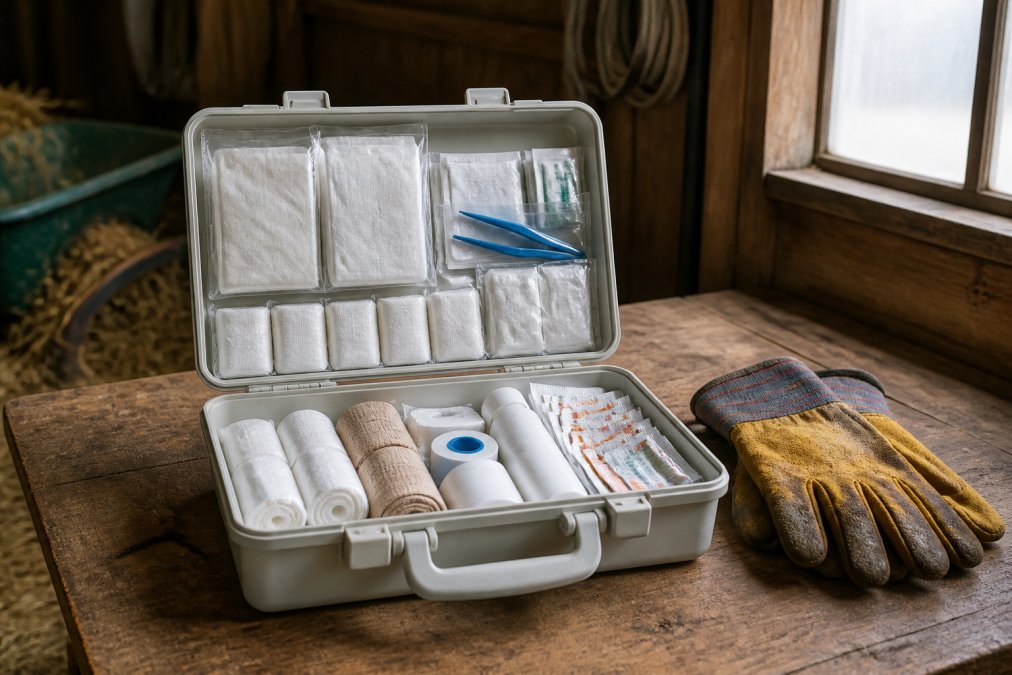
For people, prioritize wound care and bleeding control: gauze pads in multiple sizes, trauma shears, antiseptic wipes, antibiotic ointment, and non-latex gloves. Add a cold pack for sprains and a thermal blanket for shock. These handle the majority of farm injuries, which tend to be cuts, punctures, and crush injuries rather than the minor scrapes a home kit covers.
For livestock and working animals, the checklist shifts. You need veterinary wound spray, styptic powder for bleeding control on minor cuts, vet wrap that stays put through movement, and electrolyte supplements for stressed or sick animals. A slip leash and digital thermometer belong in any kit that serves dogs or livestock.
| Supply Category | People | Livestock/Poultry |
|---|---|---|
| Wound Care | Gauze pads, trauma shears, antiseptic wipes | Vet wrap, wound spray, styptic powder |
| Medications | Antibiotic ointment, hydrocortisone | Electrolytes, probiotic supplements |
| Tools | Splinter forceps, cold pack | Slip leash, thermometer, irrigation syringe |
| Protection | Nitrile gloves, tape | Non-latex gloves for handling |
Fast Comparison: Farm Supply Vendor Options
Most small farm operators default to one of three sourcing channels: national industrial suppliers, farm supply cooperatives, or specialized safety retailers. Each has a distinct economic profile that becomes obvious only when you calculate the true cost per usable item, not the shelf price.
The Real Cost of Industrial Suppliers
National industrial suppliers like Grainger or Amazon Business offer convenience and volume, but their pricing model penalizes low-frequency buyers. A typical 100-count box of adhesive bandages might cost $8, but you'll use maybe 15 in a season. The remaining 85 expire in your barn, making your effective cost per bandage $0.53 instead of the $0.08 you thought you were paying. The same logic applies to gauze, tape, and antiseptic wipes.
Industrial suppliers also rarely stock veterinary-specific items. You cannot order a single tube of styptic powder or a poultry wound spray from their standard catalogs. This forces you into a second, third, or fourth order from different vendors, each with its own shipping fee and minimum threshold.
The Cooperative Gap
Local farm supply cooperatives (like Tractor Supply or Southern States) carry basic livestock items, wound sprays, electrolytes, syringes, but their human first aid selection is often limited to a dusty shelf of home kits. You will not find trauma shears, irrigation syringes, or veterinary-specific wound dressings there. For a diversified operation, this means two separate trips and two separate inventories that never integrate into a single response plan.
The Specialized Retailer Model
Specialized retailers like RestockYourKit.com solve the cost-per-use problem by selling individual quantities at near-wholesale prices. Instead of buying 100 bandages, you buy 10. Instead of a $40 pre-assembled kit with items you'll never touch, you build a custom restock order that matches your actual consumption pattern.
Here is a practical cost comparison for a typical small farm (5-20 birds, one working dog, two people):
| Item | Industrial Bulk Price | Specialized Individual Price | Realistic Annual Usage | Industrial Waste |
|---|---|---|---|---|
| Adhesive bandages (100 ct) | $8.00 | $1.50 (10 ct) | 15 | ~85% |
| Gauze pads (200 ct) | $12.00 | $2.00 (20 ct) | 25 | ~87% |
| Antibiotic ointment (case of 24) | $36.00 | $3.50 (single tube) | 2 | ~92% |
| Vet wrap (case of 12) | $24.00 | $4.00 (single roll) | 3 | ~75% |
When you factor in the expiration waste, the specialized individual-purchase model is often 30-50% cheaper on an annual basis, even though the per-unit price is slightly higher. The tradeoff is planning: you must track your inventory and reorder before you run out, rather than relying on a bulk stockpile.
The Build-to-Order Tradeoff
Specialized retailers that build kits to order (like RestockYourKit.com) ship fresher product, but they typically need 3-5 business days for assembly. This is a meaningful constraint for emergency response planning. The mitigation is simple: maintain a small backup stock of critical items (gloves, gauze, antiseptic) and reorder the rest on a quarterly schedule, not when you run out.
The bottom line: the cheapest vendor is not the one with the lowest shelf price, it is the one whose packaging and minimums match your consumption rate. For most small farms, that means a hybrid approach: a specialized retailer for human and livestock first aid, and a local cooperative only for emergency same-day purchases.
Bulk Medical Supply Refills Without the Bulk Pricing
Bulk medical supply refills usually mean buying far more than a small farm will use before expiration. That's the core frustration with industrial suppliers: they're built for high-volume consumption, not for a diversified operation where you might use three gauze pads a month.
The smarter approach is modular refills. Buy a quality kit once, then replenish individual items as you use them. This keeps your inventory fresh and your costs predictable. Instead of replacing an entire kit annually because a few items expired, you restock only what you actually consumed.
This is where RestockYourKit.com's model fits small farms. Individual quantities of medical supplies at near-wholesale prices mean you can buy exactly what your farm first aid kit checklist calls for, without padding an order to hit a minimum. Free shipping on orders over $79 within the US makes it viable to restock as needed rather than stockpiling.
Which Small Farm Kit Setup Fits Your Operation?
Match your kit setup to your actual farm enterprises rather than buying one kit for everything. A poultry-only operation needs different supplies than a mixed farm with livestock and working dogs.
For backyard flocks of 5-20 birds, the Basic Backyard Chicken First Aid Kit at $49.99 handles the common issues: wounds, bumblefoot, mites, and basic respiratory care. For larger flocks or breeders, the Deluxe Backyard Chicken First Aid Kit at $129.98 adds premium brands like VetRx and Rooster Booster, plus more advanced tools including a 10ml irrigation syringe and styptic powder.
For operations with dogs, cats, or other working animals, add a dedicated pet kit. The TRAIL HOUND Pet First Aid Kit at $24.99 balances coverage and portability with a tick twister and common medications. The IDITAROD version at $64.99 is the most comprehensive option, adding a slip leash, hydrogen peroxide, and a digital thermometer.
Conclusion: Stock Smart, Not Just Stocked
An MFASCO alternative for small farms isn't about finding another industrial supplier with better marketing. It's about matching your safety supplies to the reality of diversified farm work, where people care and livestock care happen side by side, and where buying 100 of anything usually means wasting most of it.
RestockYourKit.com solves that problem with custom-built kits and individual supply quantities at near-wholesale prices. The specialized poultry and animal kits cover what generic suppliers ignore, and the modular refill approach means you maintain readiness without maintaining a warehouse. Get started with RestockYourKit.com and build a farm first aid setup that actually matches your operation.
Frequently Asked Questions
What should be in a first aid kit for a small farm?
A solid farm kit covers both people and animals. For people, include gauze pads, trauma shears, antiseptic wipes, and a CPR mask. For livestock and poultry, add wound spray, triple-antibiotic ointment, vet wrap, and styptic powder. Use our farm first aid kit checklist as your starting point, then adjust for your specific operation, whether that is a small flock of chickens or a few larger animals.
How do you choose a medical supply vendor for agricultural use?
Look for a vendor that sells in the small quantities a farm actually needs. Many industrial suppliers like MFASCO push bulk medical supply refills that expire before you use them. Check that the vendor custom-builds kits to order so you get the longest expiration dates possible. Confirm they stock specialized poultry and livestock items, not just human first aid gear.
Are there specialized first aid kits for livestock and poultry owners?
Yes. RestockYourKit.com offers the Basic Backyard Chicken First Aid Kit for $49.99 and the Deluxe Backyard Chicken First Aid Kit for $129.98. These include species-specific items such as Sav-a-Chick electrolytes, VetRx poultry aid, and Backyard Chicken Care Cards. For working dogs on the farm, the TRAIL HOUND Pet First Aid Kit covers bites, wounds, and common emergencies when the vet is far away.
What are the OSHA requirements for first aid kits on farms?
OSHA standard 29 CFR 1910.151 requires employers to ensure medical personnel are available for advice and consultation. In practice, that means having a first aid kit readily accessible. The contents must be adequate for the types of injuries that could occur on your farm. OSHA compliant first aid kits for agriculture should include bandages, gauze, antiseptics, and eye irrigation supplies, stored in a visible, accessible location.
How often should you restock farm medical supplies?
Check your kit every 90 days. Look for expired medications, used bandages, and damaged packaging. Because RestockYourKit.com builds kits to order, you start with the longest possible expiration dates. When you need to restock, buy only the individual items that are low, rather than replacing an entire kit. This approach keeps your farm first aid kit checklist current without waste.