

Medical Kit Sourcing and Quality Assurance Guide
Table of Contents
- Why Medical Kit Sourcing and Quality Assurance Decide Whether Your Kit Works
- FDA Medical Device Registration Requirements for Kit Components
- Vendor Vetting and Supplier Qualification: A Step-by-Step Audit Process
- Medical Supply Chain Quality Control From Factory to Shelf
- How to Build Custom First Aid Kit Modules That Stay Compliant
- In-House vs. Outsourced Kitting: A Cost-Benefit Breakdown
- Digital Traceability and Post-Market Surveillance for Kit Sourcing
- Conclusion: Building a Sourcing Process You Can Trust
- Frequently Asked Questions
Last Updated: September 14, 2026
Why Medical Kit Sourcing and Quality Assurance Decide Whether Your Kit Works
A first aid kit is only as good as its weakest item. Medical kit sourcing and quality assurance determine whether your supplies perform when someone needs them, and most buyers don't think about it until a dressing is compromised or medication has expired.
The stakes are higher than most people assume. The FDA's guidance on medical device quality systems makes clear that manufacturers must build quality into the product itself, not just inspect it at the end. That principle applies whether you're stocking a single car kit or outfitting a Scout troop for a week in the backcountry.
Medical kit sourcing is selecting, verifying, and purchasing supplies from suppliers who can prove their products meet regulatory and quality standards. Quality assurance confirms those products stay safe through storage, shipping, and use. Rigorous standards for verifying gear quality often necessitate a deeper understanding of domestic manufacturing protocols to ensure that every component remains compliant with established safety benchmarks.
Here's what most guides miss: sourcing and quality assurance aren't one-time steps but a loop. A vendor that passed your audit last year may have changed suppliers, and a batch that tested clean in March can degrade by August.
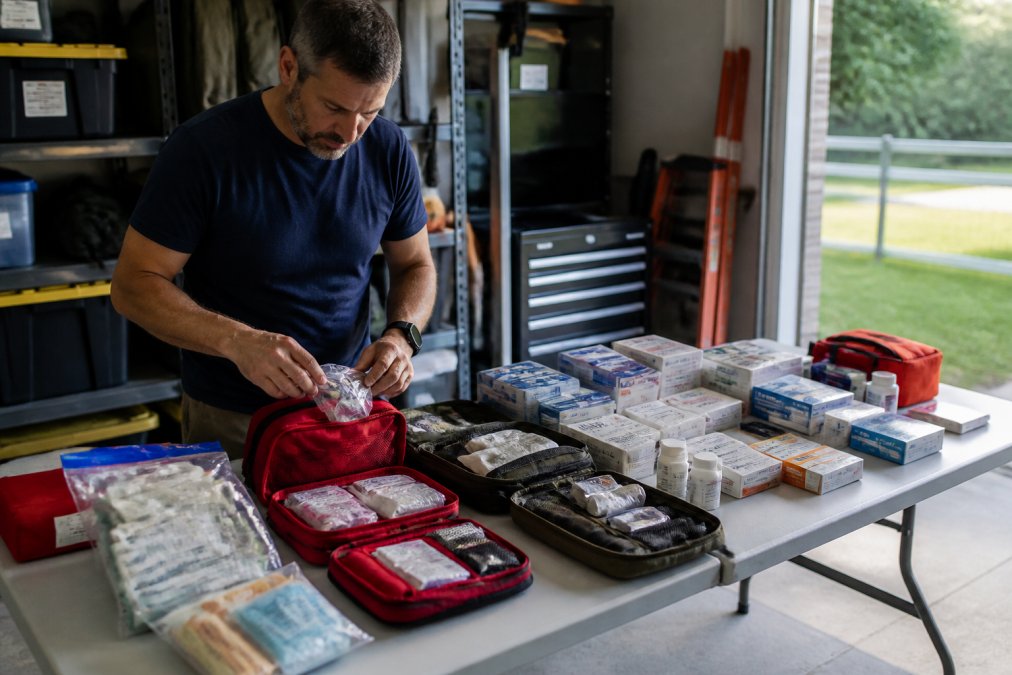
FDA Medical Device Registration Requirements for Kit Components
Many first aid kit components qualify as medical devices in the United States, so understanding FDA medical device registration requirements keeps you from stocking unregistered or mislabeled products. The FDA classifies devices by risk: most standard kit items, adhesive bandages, elastic wraps, tongue depressors, are Class I, while certain wound closure strips or sterile syringes may be Class II and require additional clearance pathways.
What this means in practice:
- Establishment registration: Domestic and foreign facilities that manufacture or process devices must register with the FDA and list their devices.
- Labeling rules: Device labels must carry the manufacturer's name, intended use, and any required warnings. Missing labeling is a red flag.
- Premarket pathways: Class II devices typically need 510(k) clearance before they can be legally marketed.
For kit assemblers, the takeaway is documentation. Ask every supplier for registration numbers, device listing confirmations, and current labeling samples. If a vendor can't produce them, walk away.
Vendor Vetting and Supplier Qualification: A Step-by-Step Audit Process
Vendor vetting is the most underrated step in medical kit sourcing. A supplier that looks legitimate online can still ship expired stock or substitute a cheaper component without telling you. Use this audit process before your first order, then repeat it annually:
- Collect baseline documents. Request business license, FDA establishment registration, device listings, and any ISO certifications the supplier holds.
- Verify, don't just receive. Cross-check registration numbers against the FDA's public database. Confirm certification bodies are accredited.
- Request a quality manual. A real manufacturer has written standard operating procedures for handling, storage, and complaint resolution.
- Ask for lot-level traceability. Can the supplier trace a finished product back to raw material batches? If not, batch traceability is broken.
- Order a sample. Inspect packaging, expiration dates, and labeling against what was promised.
- Score and document. Rate each vendor on a simple scale and keep the record for your next review cycle.
For teams building custom first aid kit modules, this matters even more: one weak link undermines the whole kit.
Medical Supply Chain Quality Control From Factory to Shelf
Medical supply chain quality control is the set of checkpoints that keep defective products from reaching your kit, from raw materials to the box on your shelf. "Inspect your shipments" is useless without knowing what to inspect, what document to demand, and which federal system to check.
A workable control system covers four points, each with a specific mechanism you can verify:
- Incoming materials: The manufacturer should have a documented receiving inspection procedure under its quality system. Ask for the supplier's incoming inspection SOP and a sample receiving record. If they cannot produce one, the quality system is not functioning.
- In-process checks: Look for evidence of in-process inspection at defined intervals, not just at final assembly. A real manufacturer can show you a traveler or batch record with sign-offs at each stage.
- Finished goods testing: For sterile items, this means sterilization validation records and seal integrity testing. For non-sterile items, it means functional testing against the product's labeled specifications. Ask for the validation protocol and the most recent test report.
- Storage and transport: Temperature and humidity controls protect items sensitive to heat or moisture. Ask what data loggers or environmental monitoring the distributor uses, and request a sample shipment record.
If you buy from a distributor rather than a manufacturer, ask what controls sit between the factory and your door. Many distributors simply repackage and reship with no inspection at all. That gap is where counterfeit and expired goods enter the market, and it's why the FDA's counterfeit medicine guidance urges buyers to purchase only from verified, licensed sources.
The Federal Systems That Back Up Your Inspection
Three public systems verify a supplier's claims without trusting their paperwork:
- FDA Establishment Registration and Device Listing database. Every establishment that manufactures, prepares, assembles, or processes a device must register and list its devices. Search the establishment name and confirm the registration is active and the listing matches what you're buying.
- FDA Recall Database. Before a repeat order, search the product name and manufacturer. An unresolved recall is a stop-buy signal.
- FDA Warning Letters and Import Alerts. A supplier with an open warning letter or import alert on its product line should not be used, regardless of price.
Where Counterfeits and Expired Stock Actually Enter
Counterfeit and expired medical supplies rarely come from a legitimate manufacturer. They enter through three channels:
- Gray-market distributors that buy surplus or short-dated stock and resell it without authorization.
- Repackagers that buy in bulk, relabel, and ship with no lot traceability.
- Online marketplaces where the seller of record is not the manufacturer and cannot produce a device listing.
The defense is the same in all three cases: demand lot-level traceability, verify the establishment registration, and refuse any shipment whose labeling doesn't match the device listing. If the supplier can't tell you which lot is in the box, you can't check it against a recall.
A Practical Incoming Inspection Checklist
When a shipment arrives, run this check before it goes into inventory:
- Confirm the lot number on each unit matches the packing slip and the manufacturer's listing.
- Check expiration dates against your minimum remaining shelf-life policy (many procurement teams set 80% of total shelf life as the floor).
- Inspect sterile packaging for breaches, punctures, or moisture.
- Verify labeling includes the manufacturer name, intended use, and any required warnings.
- Photograph anything that looks off and log it against the supplier's file.
That log becomes your leverage: a supplier with three logged discrepancies in a year is one you replace.
How to Build Custom First Aid Kit Modules That Stay Compliant
Building modular kits gives you control over what's inside and simplifies restocking. Most guides treat this as a packing exercise; it's actually a documentation exercise, the documentation keeps you out of trouble when a component is recalled or a regulator asks questions.
Start by defining your use cases. A car kit, a wilderness kit, and a poultry first aid kit each need different components; lumping them together creates waste.
Then follow these steps:
- Set the module's purpose and user. A backcountry module for a Scout troop differs from a household cold-and-flu module. Write the intended use in one sentence, that becomes the standard every component is measured against.
- List required components with quantities. Match quantities to realistic use, not worst-case fantasy. A module assuming three major bleeding events per trip is overbuilt and will expire before it is used.
- Verify each component's regulatory status. Confirm device registration and labeling for anything that qualifies as a medical device, and record the establishment registration and device listing numbers in the module's bill of materials.
- Assign expiration tracking. Note shelf life for medications and sterile items, and use the shortest-dated item as the module's expiration date.
- Build a restock schedule. Set calendar reminders tied to the shortest-dated item. A module with a 90-day item and a 3-year item should be reviewed every 90 days.
- Document the module. Keep a component list so future restocks match the original. This is the step most people skip, and the one that matters most.
The Bill of Materials Is the Compliance Document
A module without a bill of materials is just a bag of supplies. The BOM turns it into a controlled product. Capture:
- Component name and manufacturer
- Manufacturer's establishment registration number
- Device listing number (for components that are devices)
- Lot number of the current stock
- Expiration date
- Quantity required per module
- Supplier name and date last verified
A Unique Angle Most Guides Miss: Post-Market Surveillance for Kit Builders
Competitors focus almost entirely on pre-purchase sourcing. The gap is what happens after the kit is in the field. Post-market surveillance, monitoring how products perform after they're sold, can be run lightweight, without special software. Keep a simple failure log: component name, lot number, supplier, date of failure, and a one-line description. Review it quarterly. Three patterns to watch for:
- Repeat failures from the same supplier. That is a vendor qualification problem, not a bad-luck problem.
- Repeat failures from the same lot. That is a batch problem, and it may warrant a recall check.
- Repeat failures of the same component type across suppliers. That is a specification problem, and it means your BOM needs to change.
The FDA's recall database is the public counterpart to your internal log. When a manufacturer issues a recall, your BOM and lot numbers tell you whether your kit contains an affected batch. Without lot numbers, you are guessing. With them, the check takes two minutes.
Digital Traceability Without the Blockchain Hype
Blockchain-based traceability gets attention, but for most kit builders the baseline is simpler: barcodes, lot numbers, and a searchable spreadsheet or inventory system. The goal is answering one question in under five minutes: which kits in my inventory contain lot X from manufacturer Y?
Sustainability as a Sourcing Criterion
Sustainability is entering this conversation too. Reusable module pouches, refillable packaging, and reduced single-use waste appeal to buyers who want preparedness without a landfill cost. Favor refillable formats wherever sterility isn't compromised, and document which components can be refilled versus replaced sterile, that distinction belongs in the BOM, not a marketing claim.
In-House vs. Outsourced Kitting: A Cost-Benefit Breakdown
The in-house versus outsourced kitting decision comes down to volume, control, and time. Neither wins universally, and the right choice changes as you grow.
| Factor | In-House Kitting | Outsourced Kitting |
|---|---|---|
| Upfront cost | Low (buy components only) | Higher (setup and minimums) |
| Control over quality | Full | Depends on partner |
| Time required | High (assembly, tracking) | Low |
| Best for | Small volumes, custom needs | High volumes, standard kits |
| Scalability | Limited | Strong |
| Traceability burden | On you | Shared with partner |
In-house assembly makes sense when kits are highly customized, volume is modest, or you want direct control over every component.
Outsourcing wins when volume climbs and consistency matters more than customization. Contract partners handle bulk purchasing, packaging, and sterilization validation at a scale impractical to replicate alone. The trade-off is visibility: you're trusting someone else's quality management system.
For most households, troops, and small crews, a hybrid works best. Buy pre-assembled modules for standard needs, then customize with individual components where your situation demands it.
Digital Traceability and Post-Market Surveillance for Kit Sourcing
Digital traceability and post-market surveillance are reshaping medical kit sourcing, and most small buyers haven't caught up.
Traceability means every component carries a record you can follow from manufacture to use. Barcodes and lot numbers are the baseline; blockchain-based systems add tamper-resistant records multiple parties can verify.
Post-market surveillance is monitoring how products perform after they're sold. For kit assemblers, the practical version is simple: log any component that failed in the field, and stop buying from vendors whose products keep failing.
Why does this matter to a small operation? Because recalls happen. When a manufacturer issues a recall, traceability is what tells you whether your kit contains an affected batch. Without lot numbers, you're guessing. The FDA's recall database lets anyone check whether a specific product or lot has been pulled, and checking it takes two minutes.
Conclusion: Building a Sourcing Process You Can Trust
The hardest part of medical kit sourcing isn't finding supplies. It's maintaining confidence in them as vendors change, batches age, and your needs shift.
RestockYourKit.com was built for exactly that problem. We offer custom-built first aid kits, individual quantities of medical supplies at near-wholesale prices, and specialized poultry and backyard chicken supplies, all with flexible refill options so your kit stays current instead of quietly expiring. Free shipping on orders of $79 or more makes restocking practical, and our expert-curated modules mean you're not assembling a kit from scratch every time something runs out.
Get started with RestockYourKit.com and build a kit you can actually trust when it matters.
Frequently Asked Questions
What are the FDA requirements for medical kit assembly?
Kit assembly requirements depend on what the kit contains and how it's marketed. If you're combining items into a finished product with a intended medical use, the FDA generally treats the kit as a Class I device, which means establishing registration, listing, and following 21 CFR Part 820 quality system rules including design controls, purchasing controls, and complaint handling. Single components like bandages or gauze may be exempt. Confirm classification before you assemble or relabel anything.
How do you verify the quality of medical supplies from a supplier?
Start with documentation: request the supplier's FDA registration number, quality management system certificate, and sterilization validation records where relevant. Then audit in person or by video walkthrough, checking batch traceability, storage conditions, and defect identification procedures. Order a sample batch and inspect it against your own acceptance criteria before committing to volume. Repeat the audit annually, and re-qualify any supplier after a defect or a change in manufacturing location.
What is the difference between medical kitting and standard supply procurement?
Standard procurement buys items individually and stops at delivery. Medical kitting goes further: you combine components into a defined configuration, assign lot numbers for batch traceability, verify kitting accuracy, and maintain documentation that ties each finished kit back to its source components. Kitting also carries regulatory weight, since the assembled kit may need its own device listing and labeling. Procurement is a purchasing function; kitting is a production and compliance function.
How can I keep a custom kit compliant after I build it?
Set up a simple standard operating procedure that covers expiration tracking, storage conditions, and reorder triggers. Log every component's lot number and expiration date when you assemble the kit, then schedule quarterly reviews to pull expired items. If you sell or distribute kits, keep complaint records and report adverse events as required. For personal or troop kits, a dated inventory sheet inside the lid does most of the work and takes five minutes to update.