

Custom First Aid Kits for Families: 2026 Guide
Table of Contents
- Why Custom First Aid Kits for Families Outperform Generic Options
- Essential Supplies: Your DIY First Aid Kit Checklist
- Pediatric First Aid Kit Essentials for Households with Children
- OSHA and ANSI Standards for Home and Family Safety Kits
- Building Custom First Aid Kits for Families: Room-by-Room and On-the-Go
- Your First Aid Kit Refill Checklist: Expiration Management Made Simple
- Integrating Your Kit into a Broader Family Emergency Plan
- Conclusion
Last Updated: August 24, 2026
Why Custom First Aid Kits for Families Outperform Generic Options
Custom first aid kits are purpose-built around your household's specific people, health conditions, and risks, not the average household. Generic store-bought kits include supplies you'll never use while missing ones you actually need. A generic kit might include 20 adhesive bandages and a single antiseptic wipe. A custom kit for a family with two young kids, a dog, and a parent who hikes looks completely different: it includes wound care sized for small fingers, burn treatment supplies, blister pads, and a tick removal tool.

According to OSHA's first aid guidelines for general industry, workplace kits must meet specific supply standards. While home kits aren't legally mandated, applying those standards to your family kit is a smart baseline that generic kits rarely meet.
Custom kits also solve the maintenance problem. When you build intentionally, you know exactly what's in it, why it's there, and when it expires, making you more likely to actually use and update it over time.
Essential Supplies: Your DIY First Aid Kit Checklist
A solid DIY first aid kit covers wound care, burn and blister treatment, medications, tools, and emergency response basics. The goal is handling injuries most likely to happen to your family between now and when professional care is available.

Wound Care and Bleeding Control
Cuts, scrapes, and lacerations are the most common household injuries. Having the right supplies on hand turns a stressful moment into a manageable one.
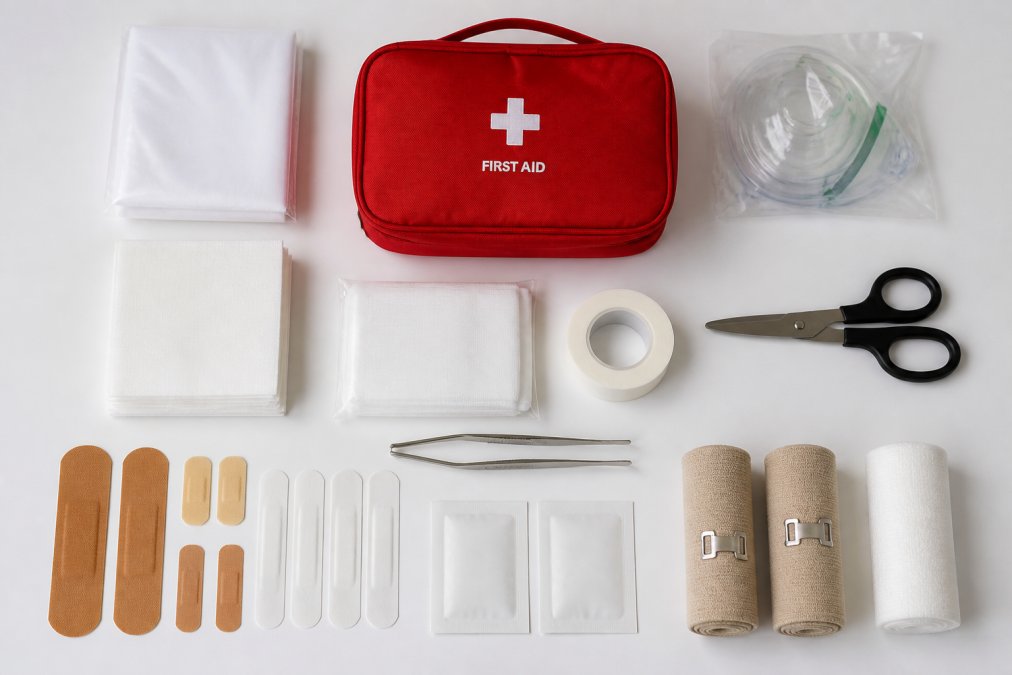
Your wound care supplies should include:
- Adhesive bandages in multiple sizes (standard, knuckle, and fingertip)
- Absorbent compress dressings for larger wounds
- Sterile gauze pads (2x2 and 4x4 inch)
- Rolled gauze bandages
- Medical-grade adhesive tape
- Nitrile gloves (at least two pairs)
- Tweezers for splinter and debris removal
- Medical scissors or bandage shears
- Antiseptic wipes for wound cleaning
- Wound closure strips for deeper lacerations
Buy more supplies than you think you need. A single wound can go through several dressings during cleaning and redressing.
Burn Treatment and Blister Care
Burns and blisters require specific treatment approaches different from standard wound care.
Burn treatment essentials:
- Sterile burn dressings or burn gel pads
- Non-adherent dressings (standard gauze sticks to burns)
- Blister cushions and moleskin padding
- Aloe vera gel for minor thermal burns
Cool running water for 10-20 minutes is the correct initial response, as noted in American Red Cross burn first aid guidance.
Medications, Tools, and CPR Barrier
This section is where most generic kits fall shortest.
Medications to include (check for household allergies and consult a healthcare provider):
- Oral antihistamine for allergic reactions
- Pain reliever appropriate for your household members
- Antacid tablets
- Electrolyte packets for heat-related illness
Essential tools:
- Digital thermometer
- CPR barrier mask or face shield (non-negotiable for any kit)
- Emergency mylar blanket
- Instant cold packs
- SAM splint for fracture stabilization
- Medical inventory list with household member health information
The CPR barrier mask is worth emphasizing separately. Basic life support training is only useful if you have the right equipment on hand. A CPR barrier mask costs very little and removes a major hesitation point in a cardiac emergency.
| Supply Category | Key Items | Priority Level |
|---|---|---|
| Wound care | Bandages, gauze, antiseptic wipes, gloves | Essential |
| Burn and blister | Burn dressings, blister pads, aloe gel | High |
| Medications | Antihistamine, pain reliever, antacid | High |
| Tools | Thermometer, CPR barrier, cold packs | Essential |
| Emergency | Mylar blanket, SAM splint, inventory list | High |
Pediatric First Aid Kit Essentials for Households with Children
Children's physiology differs from adults in ways that affect both supply selection and dosing. Pediatric first aid kit essentials go beyond just "smaller bandages."

Bandage sizing matters. Standard adult-sized bandages don't conform well to small fingers and knees. Stock knuckle bandages and small-format adhesive bandages specifically. Character-printed bandages reduce distress in young children, making wound care easier.
Medication dosing is weight-based. Children's pain relievers and antihistamines are dosed by weight, not age. Include a current weight chart for each child in your kit's medical inventory, updated at least annually.
Fever management supplies include a reliable rectal or temporal artery thermometer (more accurate for young children) and age-appropriate fever reducers.
Choking response tools such as a bulb syringe for infants and a written guide to pediatric choking response protocols belong in any kit where children under five are present.
Allergy documentation is critical. If any child has a known allergy, that information and any prescribed emergency medication should be stored with the kit, noted clearly on the outside.
The American Academy of Pediatrics guidance on home safety recommends that families with young children review their emergency preparedness supplies annually.
OSHA and ANSI Standards for Home and Family Safety Kits
OSHA and ANSI don't regulate home first aid kits directly. However, the standards they've established for workplace kits provide the most rigorous and medically validated baseline available.
OSHA's 29 CFR 1910.151 general industry first aid standard requires that employers maintain "adequate first aid supplies." The specific supply lists are defined by ANSI/ISEA Z308.1, last updated in 2021.
The ANSI Z308.1 standard defines two classes of kits:
- Class A: Designed for common workplace injuries, cuts, burns, and sprains. This is the appropriate baseline for most home kits.
- Class B: Designed for more complex or high-risk environments with broader supplies and higher quantities.
For a family home, building to Class A standards means your kit will include the right types of supplies in quantities sufficient for meaningful use, a higher bar than most generic store kits meet.
OSHA compliance matters if you run a home-based business or have employees working in your home. Check your specific situation with a qualified safety professional.
Building Custom First Aid Kits for Families: Room-by-Room and On-the-Go
The most practical approach is a distributed system rather than a single large kit. One kit in a closet does not serve a family well. Distributed kits, one per high-risk location, do.
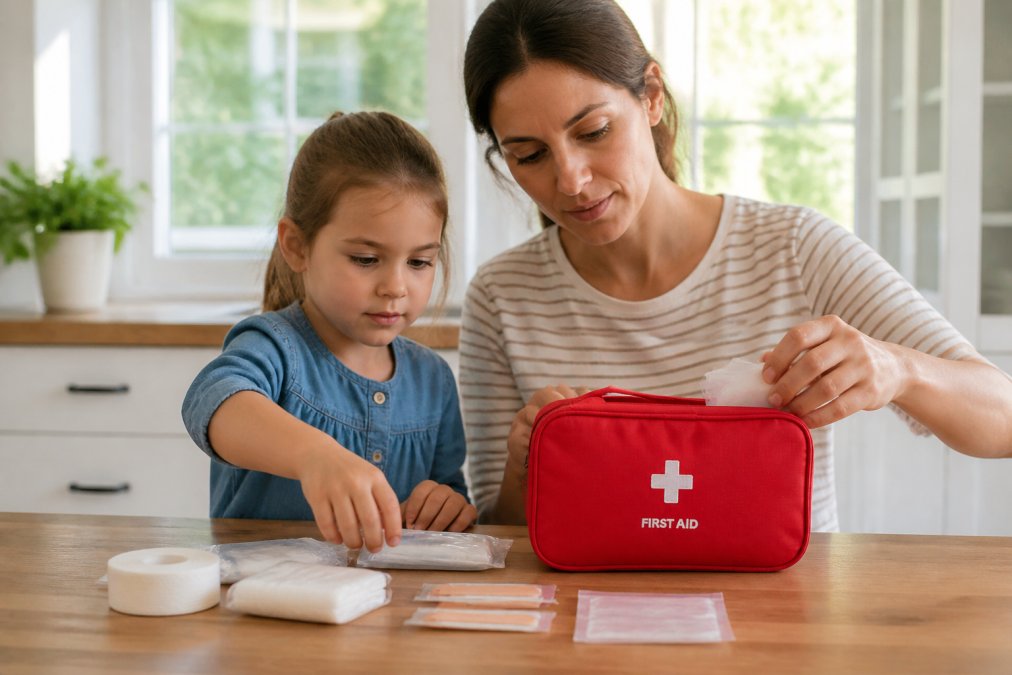
Think about where injuries actually happen in your household. The kitchen (burns, cuts), the bathroom (slips, cuts), the garage (lacerations, chemical exposure), and the car (accidents, travel injuries) each have distinct risk profiles. home diagnostic equipment.
Kitchen: Focus on burn treatment, wound care, and eye wash. Keep it accessible to adults but out of reach of young children.
Bathroom: Stock wound care basics and medications. This is often where minor injuries get treated.
Garage or workshop: Heavier wound care, eye wash station, and chemical exposure response supplies.
Bedroom or hallway: A general-purpose kit for nighttime emergencies.
Home Kit vs. Car Kit: What Changes
The car kit is distinct from the home kit. Car kits need to handle trauma care from vehicle accidents, exposure injuries from being stranded, and fit in a compact space.
Car kit priorities differ from home kit priorities:
- Trauma supplies take precedence: absorbent compress dressings, tourniquet (if trained), and wound closure strips
- Emergency mylar blanket and hand warmers for exposure
- Compact format: the kit needs to fit in a glove compartment or under a seat
- Heat tolerance: supplies stored in a car experience extreme temperature swings
The RestockYourKit.com Basic Car + Home First Aid Kit at $19.99 is a practical starting point for vehicle readiness. For solo drivers or couples who want more coverage, the Individual First Aid Kit at $41.99 adds trail-specific supplies.
Eco-Friendly and Sustainable Supply Choices
Sustainability in first aid kits doesn't require compromising on safety.
Practical eco-friendly choices for custom kits:
- Paper-based or compostable packaging on bandages and wipes where available
- Reusable storage cases made from durable materials that don't need frequent replacement. The Weekender First Aid Bag from RestockYourKit.com uses durable Oxford nylon construction, significantly outlasting disposable plastic cases
- Concentrated antiseptic solutions that reduce packaging waste versus single-use wipes
- Avoiding over-packaging: buy individual supply quantities rather than pre-packaged kits with unnecessary fillers
A durable, well-organized case makes you more likely to refill and maintain the kit rather than throw it away and buy a new one.
Your First Aid Kit Refill Checklist: Expiration Management Made Simple
Building the kit is the easy part. Keeping it current is where most families fail.
A first aid kit refill checklist is a systematic approach to reviewing your kit's contents on a regular schedule.
Annual full audit (set a calendar reminder every January):
- Check expiration dates on all medications, discard and replace any expired items
- Check expiration dates on antiseptic wipes and sterile dressings
- Verify CPR barrier mask is intact and sealed
- Replace any used or partially used supplies
- Update the medical inventory sheet with current household member information
- Verify emergency contact numbers are current
Seasonal spot checks (quarterly):
- Check car kit for heat or cold damage to supplies
- Restock any items used since the last check
After any use:
- Replace every item used immediately, not "eventually"
- Note what was used and whether the kit had the right supplies
RestockYourKit.com lets you buy individual quantities of specific supplies at near-wholesale prices. You don't have to buy a full replacement kit every time you use three bandages and an antiseptic wipe. That modular approach makes long-term kit maintenance affordable and realistic.
Integrating Your Kit into a Broader Family Emergency Plan
A first aid kit is a component of emergency preparedness, not a substitute for it. The most well-stocked kit is less useful if people in your household don't know where it is, how to use it, or how it fits into a broader response plan.
Emergency response planning for families should connect the first aid kit to several other systems:
Location and access: Every adult and older child should know where every kit is stored.
Basic life support training: A CPR barrier mask is only useful if someone in the household has first aid certification or has watched a CPR instructional video recently. The American Heart Association's hands-only CPR resources provide free, accessible training in less than two hours.
Communication protocols: Your emergency plan should include who calls 911, who retrieves the kit, and who manages children or other household members during an emergency.
Integration with evacuation plans: If your family has a home evacuation plan for fire or natural disaster, the car kit and a grab-and-go bag should be part of that plan.
Documentation: Store a laminated card in your main kit that includes household member names, ages, weights (for children), known allergies, current medications, and emergency contacts including the nearest hospital and poison control center (1-800-222-1222 in the US).
Triage basics are worth reviewing annually as a family. Knowing how to prioritize injuries, life-threatening bleeding first, then airway, then everything else, is a skill that degrades without reinforcement.
Building and maintaining a genuine family safety system takes more thought than grabbing a generic kit off a shelf, but the gap in preparedness is significant. RestockYourKit.com makes the custom approach practical: individual supply quantities at near-wholesale prices, modular kit options from the $15.99 Micro-Kit DELUXE (First Aid Kit) to the $41.99 Individual First Aid Kit, and the flexibility to build exactly what your household needs. Get started with RestockYourKit.com and build a kit your family will actually rely on.
Frequently Asked Questions
Is it cheaper to build your own first aid kit or buy a pre-made one?
A ready-built option like the [Basic Car + Home First Aid Kit](https://restockyourkit.com/products/basic-car-home-first-aid-kit) starts at $19.99 and includes a curated selection of supplies. Buying individual items can add up quickly, and you risk duplicating supplies you already own or missing critical ones. For most families, a pre-built kit is a cost-effective starting point.
What should be in a family first aid kit?
A complete family kit should include adhesive bandages in multiple sizes, absorbent compress dressings, sterile gauze, antiseptic wipes, medical tape, burn treatment supplies, a CPR barrier mask, nitrile gloves, scissors, tweezers, a digital thermometer, and basic over-the-counter medications such as pain relievers and antihistamines. Families with children should also add pediatric-dosed medications and a bulb syringe. Custom first aid kits let you tailor quantities and add-ons to your household's specific needs.
How often should you check and restock your family first aid kit?
Check your kit at least twice a year, ideally aligning with daylight saving time changes as a simple reminder. Review every item for expiration dates, damaged packaging, or depleted quantities. Medications, antiseptic wipes, and adhesive bandages are the most commonly expired items. After any incident where you use supplies, restock immediately rather than waiting for the next scheduled check. A written first aid kit refill checklist taped inside the lid makes this process faster and less likely to be skipped.
What specific medical supplies are essential for households with children?
Households with children need pediatric-dosed pain relievers and antihistamines, a calibrated oral syringe for liquid medications, a bulb syringe for nasal clearing in infants, and smaller bandage sizes suited to little fingers and knees. Instant cold packs are especially useful for bumps and falls. A pediatric first aid kit should also include a digital thermometer, medical-grade gloves in a smaller size, and clear instructions for child-appropriate dosing. Age-specific supplies matter because adult doses and tools are not safe for young children.