Cart
0
You can have the nicest electronics on the dash and still get derailed by a fishhook in a thumb or a prop wash slip that turns into a deep cut. On the water, small problems become big because help is slower, hands are wet, and the deck is always trying to throw you.
That is why “boating first aid kit requirements” are less about a single magic checklist and more about matching supplies to your boat, your water, your crew, and your response time. Some rules exist, but the real requirement is this: you must be able to handle the first 30-60 minutes of an injury with what you already have onboard.
What boating first aid kit requirements really mean
In the US, there is no one universal federal law that says every recreational boat must carry a first aid kit. Instead, requirements show up in three places:First, your state or local jurisdiction may define required safety equipment or enforce guidance for certain waters, events, or permits. Second, an organized activity (regatta, charter operation, Scout trip, camp program) can impose its own standards. Third, your insurance, marina, or professional association may have expectations that matter when something goes wrong.
So if you are looking for a single “legal minimum,” it may not exist for your exact situation. Practically, though, there is always a minimum functional standard: the kit must be accessible, protected from water, and stocked to manage the most likely injuries on your boat.
The most common injuries on boats (and what they demand)
Boat first aid fails when it is built for generic household boo-boos instead of wet, sharp, moving hardware.Cuts and lacerations are the big one. You have knives, hooks, fins, fillet stations, cleats, rigging, and sharp fiberglass edges. That means your kit needs serious wound cleaning and enough dressings to cover larger areas, not just a handful of tiny adhesive strips.
Punctures are common too - fishhooks, gaffs, splinters from docks, and spines from marine life. That pushes you toward good tweezers, irrigation, and strong antiseptic options.
Sprains and strains show up with rough water and awkward footing. If your kit cannot support a wrist, ankle, or knee well enough to get you back to shore, you did not really meet the requirement.
Then there is the “water factor.” Wet skin blisters faster, tape fails faster, and hypothermia becomes a risk even in mild conditions if someone is soaked and the wind is up.
A realistic baseline: what every boat should carry
If you boat on lakes, rivers, and nearshore water with a predictable run time back to help, your baseline can be compact but it needs to be complete.You want supplies for three jobs: stop bleeding, clean and cover wounds, and manage pain or allergic reactions until you can hand off to higher care.
That means you need a way to apply pressure and dress a wound that is still oozing, not just a scrape. Include gauze in more than one size, a roll of gauze, and a couple of larger absorbent pads.
You also need reliable adhesive options. Standard bandages are fine for small cuts, but on boats you will rely heavily on strong medical tape and wrap to hold dressings when skin is damp.
For cleaning, think irrigation and wipe-down. Pre-packaged saline, sterile wipes, and a way to flush debris from a cut matter more than a tiny bottle of something that leaks.
Add blister care, tweezers, small scissors, and a CPR barrier. Finish the baseline with gloves and a small selection of individually packaged OTC medications for pain, stomach issues, and allergies - especially if you are hosting guests.
Offshore or remote trips: when “enough” changes fast
The farther you are from EMS, the more your kit has to behave like a small clinic.If you are boating offshore, on big lakes where weather can trap you, or in areas with limited cell service, your kit needs more redundancy and more capability. “One of each” is not a plan when you have multiple people and no fast exit.
Bleeding control becomes a primary concern. You are not planning for a movie-style catastrophe, but you are acknowledging that props, winches, anchors, and knives can create serious wounds. A tourniquet, a hemostatic dressing, and a pressure dressing are reasonable adds when your response time is long. Training matters here - carrying advanced items without knowing how to use them can create hesitation at the worst moment.
Exposure management rises on the list too. Hypothermia supplies do not have to be complicated, but you need the ability to insulate someone and keep them dry. Even a light emergency blanket and a way to get warm fluids onboard can be meaningful.
Finally, think about infection risk. Salt water, fish slime, and grit in a wound are a bad combination. More irrigation, more dressings, and a plan to keep a wound covered and clean for hours are part of offshore reality.
Kids, groups, and Scout crews: volume is a requirement
Group boating changes everything because consumption is the hidden problem. A kit that looks “fully stocked” for a couple can be empty after one busy afternoon with a dozen people.With kids, you go through adhesive bandages, antiseptic wipes, and blister supplies quickly. With teens and adults, you go through gauze, wrap, and meds. The requirement is not just having the item, it is having enough of it.
Also consider who will use the kit. If multiple adults might treat an injury, organize it so the basics are fast to grab. Confusion costs time and wastes supplies.
Storage and access: the part most kits get wrong
A first aid kit that lives under three life jackets, behind a cooler, is not really onboard.Your kit should be reachable with one hand while stabilizing yourself. That usually means a dedicated, labeled spot near the helm or the companionway, plus a smaller “quick access” module if you spend time on the bow or in the cockpit.
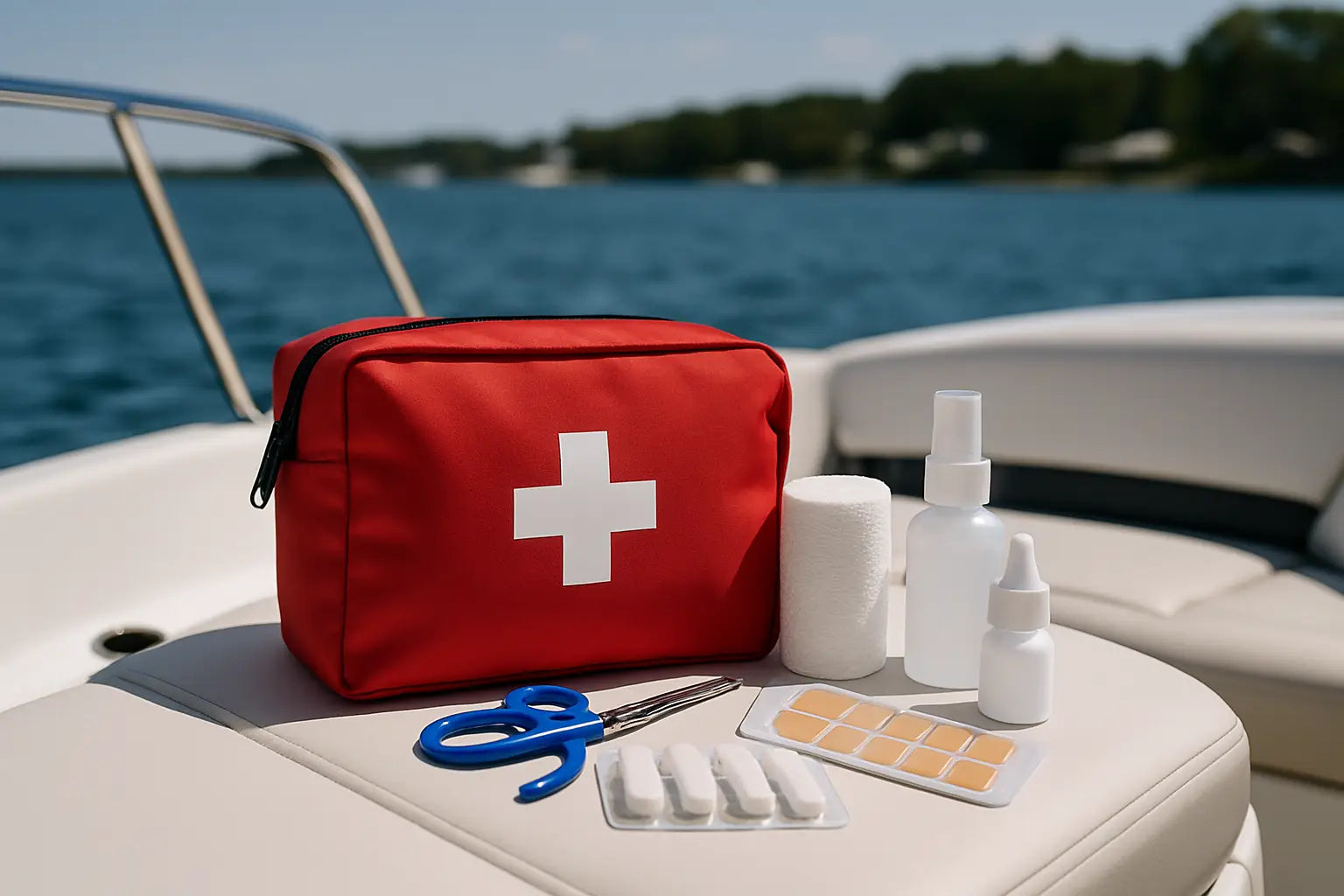
Water protection is not optional. Use a dry bag, gasketed box, or a purpose-built bag with internal pouches. Humidity and spray ruin meds, adhesives, and anything paper-wrapped.
Heat is the other silent killer. Kits stored in hot compartments can degrade medications faster. If your boat bakes in the sun, rotate meds more often and consider storing the kit where temperatures are more stable.
Medications onboard: useful, but plan for your crew
OTC meds are some of the highest value items in a boating kit because they keep small issues from becoming trip-ending problems. But medications come with trade-offs.If you supply meds for a group, single-dose packets help with hygiene and with tracking what was taken and when. Still, you should be cautious about allergies, interactions, and age restrictions. The safest approach is to stock common options, keep them in original labeled packaging, and let adults self-administer when possible.
Seasickness is worth specific attention. If someone gets sick early, dehydration and fatigue follow. Have a plan before you cast off, not after the horizon starts moving.
Special situations that change requirements
Fishing-focused trips have higher puncture and laceration risk. Add better tweezers, stronger cleaning supplies, and dressings that handle wet environments.Paddling and small-craft outings tilt toward exposure, blisters, and entanglement. A compact kit is fine, but it should include blister care and a way to manage hypothermia.
Freshwater river boating can mean more abrasions and more contamination from silt and organic debris. Irrigation and good wound coverage matter.
If you are on a vessel with fuel systems, cooking gear, or heaters, burn care becomes more relevant. A burn dressing and pain control supplies can make a big difference while you head in.
A restock mindset: the real “requirement” for preparedness
Most boaters do not fail to buy a kit. They fail to keep it usable.Adhesives get used and never replaced. Gloves dry out. Meds expire. A kit slowly becomes a bag of odds and ends that looks reassuring until you need it.
Build a simple habit: after every trip where the kit gets opened, restock within 48 hours. If you run a seasonal boat, do a pre-season and mid-season check. That is not overkill - it is how you avoid discovering empty gauze rolls at the worst time.
Modular refills make this easier because you can replace just what you used instead of buying another entire kit. If you like that style of system, you can find boating-focused kits and small-quantity refills at RestockYourKit.com that are curated with remote and wilderness medicine realities in mind.
What to tell yourself before leaving the dock
If you are trying to meet boating first aid kit requirements, ask one question that cuts through the noise: “Can I handle bleeding, cleaning, and stabilization for long enough to reach help, with the people and conditions I actually have today?”Answer it honestly, then pack for that answer - and give your future self the gift of putting the kit back in fighting shape the moment you get home.